How to Read Your Hormone Blood Panel: 2026 Guide
- 2 days ago
- 12 min read
What if the very lab report that says you are "normal" is actually the reason you still feel exhausted, foggy, and frustrated? It's a common experience to visit a physician with clear symptoms only to be told your results fall within the standard reference range. Learning how to read your hormone blood panel is about more than just checking boxes. It's about understanding how these numbers translate to your daily performance. As of May 2026, new FDA regulations on laboratory tests have increased the precision requirements for these results, but the interpretation remains the most critical factor for your health.
You likely suspect that "average" isn't the same as "optimal," and you're right to trust that intuition. We promise to help you look beyond the clinical minimums to find the functional peaks where you actually feel your best. This guide breaks down the 2026 standards for markers like testosterone and LH while explaining why a TSH of 3.8 might be "normal" at a standard lab but sub-optimal for your energy levels. You'll gain the clarity needed to identify which specific markers are driving your symptoms and the confidence to discuss a personalized treatment plan with a specialist.
Table of Contents
The 'Normal' vs. 'Optimal' Debate: Why Your Lab Results Might Be Misleading
A hormone blood panel serves as a high-resolution diagnostic snapshot of your endocrine health. It captures the concentration of chemical messengers that dictate your mood, metabolism, and muscle mass at a specific moment in time. However, knowing how to read your hormone blood panel requires understanding that a number on a page doesn't exist in a vacuum. It must be viewed through the lens of how you actually feel and perform. Many patients are surprised to find that their results are labeled "normal" even when they feel far from it.
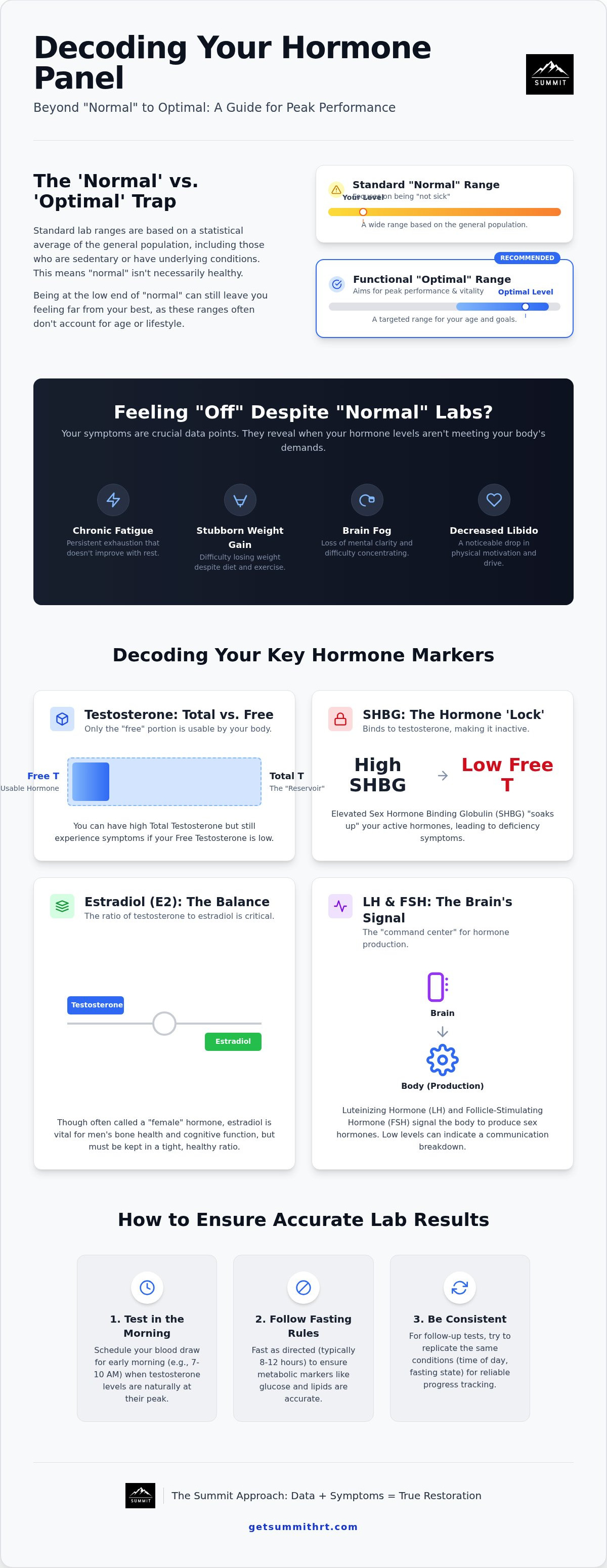
Most people assume that "normal" means healthy. In reality, Reference ranges for blood tests are calculated using a statistical bell curve of the general population. This means the range is based on everyone who walked into that lab recently, including people who may be sedentary, chronically stressed, or suffering from undiagnosed conditions. Being in the bottom 5% of a "normal" range often means you're just a few points away from a clinical deficiency. Yet, because you're still within that broad curve, you might be told everything is fine. This creates a psychological burden, leaving you to wonder why your energy is failing despite a "clean" bill of health.
Understanding the Reference Range Trap
Standard labs rarely distinguish between a 30-year-old in their physical prime and an 80-year-old retiree when setting these benchmarks. If your testosterone or estrogen levels are "normal" for someone decades older than you, you'll likely experience a significant drop in vitality. Laboratories also update these ranges periodically based on a declining national average. As the general population's health markers shift downward, the "normal" bar continues to drop. We believe in pursuing optimal ranges designed for longevity and peak performance, focusing on the difference between merely being "not sick" and being fully optimized.
The Role of Symptoms in Lab Interpretation
Your bloodwork is only half of the diagnostic picture. Your symptoms are the body's way of communicating that current hormone levels, even if they look acceptable on paper, aren't meeting your physiological demands. It's common for symptoms to persist well within standard ranges. You might experience:
Chronic fatigue that doesn't improve with rest.
Stubborn weight gain despite consistent exercise and a clean diet.
A noticeable loss of mental clarity or "brain fog."
Decreased libido or a lack of physical motivation.
Functional medicine serves as the essential bridge between raw clinical data and your subjective well-being, ensuring that your treatment plan addresses the root cause of your symptoms rather than just the numbers on the page. By prioritizing how you function over where you sit on a generic chart, we can create a path toward true restoration.
Decoding the Key Markers: Testosterone, Estrogen, and Beyond
Your lab report often looks like an alphabet soup of acronyms. To truly master how to read your hormone blood panel, you must look past the individual values and see how they collaborate. While many doctors only test for Total Testosterone, this only shows the "reservoir" of hormone in your system. The real story lies in your Free Testosterone, which is the unbound portion actually available for your cells to use. If your Free levels are low, you'll still feel the symptoms of deficiency regardless of your Total count.
Sex Hormone Binding Globulin (SHBG) is the protein responsible for this disparity. Think of SHBG as a lock that prevents hormones from doing their job. When SHBG is elevated, it "soaks up" your active hormones, leaving you symptomatic. Similarly, Estradiol (E2) isn't just a "female" hormone. In men, it’s vital for bone health and cognitive function, but it must be kept in a tight ratio with testosterone. Understanding these Hormone levels requires looking at the signals from your brain too. Luteinizing Hormone (LH) and Follicle-Stimulating Hormone (FSH) act as the command center, telling your body when to produce more or less. If these are low while your sex hormones are also low, it points to a communication breakdown in the brain.
Men's Health Markers: TRT Specifics
For men exploring trt therapy, safety markers are just as important as the hormones themselves. We monitor Prostate-Specific Antigen (PSA) to ensure prostate health remains stable throughout treatment. Additionally, we track Hematocrit and Hemoglobin. These markers tell us if your blood is becoming too thick, which is a manageable but necessary side effect to watch for during optimization. Balancing these metrics ensures your journey is both effective and safe.
Women's Health Markers: HRT Essentials
Women's hormones are more cyclical, making the timing of your draw essential. When evaluating hormone replacement therapy for women, we often look at the ratio between Progesterone and Estrogen. This balance is what regulates your sleep quality and mood stability. We also prioritize DHEA-S, often called the "mother hormone," because it supports adrenal health and serves as a building block for other vital steroids. Learning how to read your hormone blood panel means knowing exactly which phase of your cycle you were in when the needle hit the vein. A comprehensive bloodwork analysis through a specialized provider ensures these nuances aren't missed.
Hormone Synergy: How Markers Interact on Your Panel
Hormones don't function in isolation; they operate as a complex, interconnected symphony. When you're learning how to read your hormone blood panel, it's easy to get fixated on a single number. However, the true story of your health lies in the ratios between these markers. For example, the Testosterone to Estrogen (T:E) ratio is often more telling than either value alone. In men, high testosterone paired with high estrogen can lead to unwanted side effects like bloating or mood swings. In women, an imbalance here can disrupt the menstrual cycle and impact bone density. You need these markers to work in harmony to feel the full benefits of optimization.
Your metabolic health and stress levels also dictate how these hormones perform. High levels of cortisol, the body's primary stress hormone, can lead to a "hormone steal" where your body prioritizes survival over reproduction. This often results in a measurable drop in your sex hormone precursors. We also look closely at fasting insulin and glucose. Insulin resistance isn't just about blood sugar; it's a major disruptor of hormonal signaling that can lower testosterone and drive systemic inflammation. If these metabolic markers are off, your hormone therapy won't reach its full potential.
The SHBG Factor: The 'Traffic Jam' of Your Bloodstream
Sex Hormone Binding Globulin (SHBG) acts as a carrier protein that regulates hormone availability by binding to them in the bloodstream. Think of it as a transport bus. If there are too many buses and they're all full, the hormones can't get off to do their work at the cellular level. This is why a Testosterone Levels Test must include free and bioavailable markers. Lifestyle factors like excessive alcohol consumption, chronic over-training, or a low-carb diet can spike SHBG, leaving you with low-T symptoms even if your "Total" number looks impressive on paper.
Thyroid-Hormone Crosstalk
Your thyroid is the master regulator of your metabolism. When thyroid function is low, a condition known as hypothyroidism, it often mimics the symptoms of low testosterone or menopause. You might feel sluggish, gain weight, or lose your mental edge. It's vital to test Free T3 and Free T4 alongside TSH to get the full picture. TSH alone can be misleading, as it only shows the brain's signal, not the actual thyroid output. At summit rejuvenation, we integrate thyroid support into our broader wellness plans because we know that sex hormones can't thrive in a body with a sluggish metabolism. True vitality requires every part of the endocrine system to pull its weight.
Preparation and Consistency: Getting Accurate Lab Results
Accuracy is the foundation of any optimization plan. To truly master how to read your hormone blood panel, you must control the variables that can skew your data. Hormones follow a strict circadian rhythm. Testing between 7 AM and 10 AM is non-negotiable because testosterone levels naturally peak in the early morning and decline as the day progresses. If you test in the late afternoon, your results may show a false deficiency that leads to unnecessary treatment or incorrect dosages.
Fasting is equally critical for a clear diagnostic picture. Consuming a high-carb breakfast or a sugary coffee before your draw can spike insulin and suppress certain hormone readings. Stick to water only. Hydration also plays a silent but vital role in your report. Dehydration can artificially elevate your hematocrit and kidney markers, making your blood appear thicker and your kidneys appear more stressed than they actually are. Proper fluid intake ensures the draw is easier and the data remains clean.
One of the most overlooked disruptors in modern lab work is Biotin. This common B-vitamin, found in many multivitamins and hair supplements, interferes with the immunoassays labs use to measure your levels. It can cause falsely high or low readings for thyroid markers and sex hormones. You must stop all Biotin-containing supplements at least 72 hours before your blood draw to ensure your results reflect your true physiological state rather than a chemical interference.
The Step-by-Step Pre-Lab Protocol
Precision requires a disciplined approach in the days leading up to your appointment. Avoid strenuous exercise for 24 to 48 hours before your test. Heavy lifting or intense cardio can cause a temporary spike in liver enzymes like AST and ALT, which might lead a physician to suspect liver stress when you're simply recovering from a leg day. Consistent sleep is also vital. Aim for at least seven hours of quality rest for three nights leading up to the draw to ensure your endocrine system is operating under stable conditions.
Tracking Your Data Over Time
A single lab test is merely a snapshot in time. While it provides a vital starting point, the real power for your health lies in the trends. When you begin TRT or HRT, quarterly testing is the gold standard for the first year. This frequency allows us to see how your body adjusts to the therapy and permits fine-tuning before symptoms have a chance to return. Using a digital portal to visualize these shifts helps you see the tangible progress toward your optimal range. Ready to establish your baseline? Start with a comprehensive bloodwork analysis to get the precise data you need for your journey.
From Data to Vitality: How Summit Rejuvenation Interprets Your Story
Understanding how to read your hormone blood panel empowers you, but raw data requires a specialist’s eye to turn those numbers into a life-changing protocol. At Summit Rejuvenation, we don't just look at where your markers land on a chart. We merge that clinical data with your unique, lived experience. If your labs say you're "normal" but you still can't lose weight or stay focused, the labs aren't telling the whole story. Our experts listen to your symptoms first. This collaborative approach ensures we treat the person, not just the paper.
Personalization is at the heart of everything we do. We reject the generic dosing models that often lead to poor results or unwanted side effects. Your protocol is built specifically for your biology. This might include integrating peptides for weight loss or high-grade vitamin therapy alongside your hormone adjustments. This comprehensive strategy addresses your vitality from every angle. We ensure your metabolism and energy levels rise in tandem with your hormonal balance. We prioritize transparency, making sure you understand exactly why each component is included in your plan.
The Telehealth Advantage for Hormone Management
Accessing high-level care shouldn't depend on your zip code. Choosing hrt online through our telehealth platform means you can review your entire panel with a specialist from the comfort of your home. You'll receive clear, honest feedback without the rush of a traditional clinic. Our model is built for your convenience:
Direct-to-home medication shipping for all protocols.
Continuous monitoring to ensure your levels stay in the optimal zone.
Streamlined lab re-orders for long-term safety and precision.
Dedicated medical consultations that prioritize your questions.
Your Path to Optimization Starts Here
Starting your journey is a methodical and supportive process. First, you'll schedule your comprehensive bloodwork through our portal. We've simplified the logistics so you can focus on your health. During your initial medical consultation, we'll dive deep into your results and your goals. We explain the "why" behind every number. Most patients begin feeling the initial effects of therapy within the first few weeks of starting their protocol. From the first blood draw to the reclamation of your vitality, we act as your dedicated partner. Your path to an optimized life is clear and professionally managed. We are ready to help you move from surviving to thriving.
Take Control of Your Hormonal Future
You now possess the foundational knowledge to understand that your lab results are more than just a list of arbitrary numbers. They are a blueprint for your restoration. Mastering how to read your hormone blood panel allows you to advocate for your own health and look beyond the limitations of standard reference ranges. By focusing on optimal levels and the synergy between markers like testosterone and thyroid function, you can finally align your clinical data with how you actually feel. You don't have to settle for "normal" when optimal is within reach.
True optimization requires a partner who values precision as much as you do. Our specialized medical consultations bridge the gap between raw data and lasting vitality through a convenient telehealth model. With direct-to-home medication delivery and expert ongoing support, your path to peak performance is clear and professionally managed. You deserve a health plan that is as unique as your biology. Schedule Your Comprehensive Bloodwork Analysis with Summit Rejuvenation Today and take the first proactive step toward reclaiming your energy and focus.
Frequently Asked Questions
What is the most important hormone to check in a blood panel?
No single hormone dictates your entire health, as your endocrine system relies on a delicate balance between multiple markers. However, Free Testosterone is frequently the most critical marker for identifying symptoms because it represents the hormone actually available for your body to use. While Total Testosterone provides a general baseline, the "free" value often explains why you feel a certain way despite having "normal" results.
Can I read my own hormone results without a doctor?
You can certainly review your own lab report, but professional interpretation is essential for safety and precision. Learning how to read your hormone blood panel is a great first step toward self-advocacy, but a specialist understands the nuances between clinical "normal" and functional "optimal." Experts can identify subtle patterns and ratios that a layperson might miss, ensuring your treatment is based on a complete picture.
Why is my testosterone 'normal' but I still have low libido?
A "normal" total testosterone level doesn't guarantee a healthy libido if your Free Testosterone is low or your Estrogen is out of balance. High levels of SHBG can bind to your testosterone, making it biologically inactive and unavailable to your tissues. Additionally, issues with prolactin or thyroid function can suppress desire even when your primary sex hormones appear adequate on a standard lab report.
Does insurance cover hormone blood panels for HRT?
Insurance coverage for hormone panels depends heavily on your specific provider and the diagnostic codes used by your physician. Many traditional plans cover basic testing if a specific deficiency is suspected, but they often decline coverage for comprehensive "optimization" panels. It's always best to verify your benefits directly with your insurance carrier or check with your specialist before scheduling your blood draw.
How often should I get my hormone levels checked?
You should typically get your levels checked every three to six months when first starting a new therapy protocol. This frequency allows your medical team to monitor how your body responds and make necessary adjustments for maximum effectiveness. Once you reach a stable, optimal state, an annual or bi-annual checkup is usually sufficient to ensure long-term safety and peak performance.
What supplements can interfere with my hormone blood test results?
Biotin is the most common supplement that interferes with lab results, often causing falsely high or low readings for thyroid and sex hormones. You should stop taking any supplements containing Biotin at least 72 hours before your blood draw to ensure accuracy. Other substances like high-dose Vitamin B12 or certain herbal boosters can also occasionally skew specific markers, so always disclose your supplement list to your provider.
Is a saliva test better than a blood test for hormones?
Blood testing remains the gold standard for clinical accuracy because it provides the most reliable measurement of hormone concentrations in the bloodstream. While saliva tests are non-invasive and can track cortisol rhythms, they often lack the precision required for prescribing medical-grade TRT or HRT. Most specialists prefer serum blood work to ensure your dosing is based on the most accurate and reproducible data available.
What time of day is best for a hormone blood draw?
The best time for a hormone blood draw is between 7 AM and 10 AM when your levels are at their natural peak. Testosterone and other key markers fluctuate throughout the day and typically reach their lowest point in the late afternoon or evening. Testing during this early morning window ensures your results are consistent with standard reference ranges and reflect your maximum daily physiological output.