Improve Mental Clarity and Focus: A Biological Approach
- 3 hours ago
- 11 min read
What if your fading professional edge isn't a lack of discipline, but a direct result of a biological imbalance that caffeine simply can't fix? You've likely tried every productivity hack and sleep schedule available, yet that persistent mental fog remains. It's frustrating to feel your sharpest ideas slip away while you search for how to improve mental clarity and focus in a world of generic advice. You know you're capable of more, but your brain feels like it's running on a depleted battery.
The truth is that mental clarity isn't just a mindset; it's a biological state dependent on hormonal balance and cellular optimization. We're going to show you exactly how to improve mental clarity and focus by looking beneath the surface at your internal chemistry. You'll discover why traditional "normal" lab results might be failing you and how a precision-based approach can restore your cognitive energy. This article provides a comprehensive, medically-backed protocol to help you reclaim your mental sharpness. We'll explore the physiological causes of brain fog, the role of targeted hormone and peptide therapies, and the specific steps you can take to maintain peak performance throughout your entire workday.
Table of Contents
Understanding the Science of Mental Clarity and Why It Fades
Mental clarity isn't just a vague sense of wellness. It's a precise biological event. This state occurs through the efficient synchronization of neurotransmitters and stable energy metabolism within your neural pathways. When these systems align, you experience a sense of effortless flow. Most people searching for how to improve mental clarity and focus are actually battling a modern epidemic of "Brain Fog" that stems from physiological depletion. Our modern environments are practically designed to strip away cognitive resources. Between the constant barrage of digital notifications and the metabolic stress of processed diets, your brain is often forced into a defensive, low-energy state.
It's vital to distinguish between surface-level distractions and deep physiological fatigue. Surface distractions are external. You can turn off your phone or close your door to fix them. However, deep fatigue is internal. It's a cellular reality where your brain's hardware is struggling to keep up with the software's demands. Cognitive clarity is the state where the brain can filter irrelevant stimuli without excessive effort.
The Symptoms of Cognitive Decline
Recognizing the early signs of biological cognitive decline is the first step toward restoration. It often starts with subtle shifts in your daily performance that feel like "just getting older," but they're actually red flags. Common indicators include:
Verbal Fluency Issues: Struggling with word-finding or losing your train of thought mid-sentence.
Caffeine Resistance: Feeling a "sluggish" heaviness that persists even after consuming multiple stimulants.
Executive Function Fatigue: Experiencing decision paralysis over routine tasks that used to feel automatic.
Common Physiological Stressors
Your brain's ability to maintain focus is constantly under siege from internal stressors. Chronic inflammation is one of the most significant factors. It can subtly compromise the blood-brain barrier, allowing toxins to interfere with neural signaling. This is often coupled with oxidative stress, which slows down the speed at which your neurons communicate. Your attentional control relies on these biological systems remaining pristine. What Harvard researchers often call "wear and tear" is frequently a result of repair mechanism failure. When your body lacks the hormonal or peptide support it needs, it can't keep up with the maintenance required for a high-performing mind. Understanding how to improve mental clarity and focus requires looking at these biological foundations rather than just trying to work harder.
The Hormonal Connection: Why Brain Fog Isn’t Just "In Your Head"
While many people focus on maintaining your mental health through meditation or sleep, the biological drivers of focus often lie deep within your endocrine system. Hormones aren't just for physical growth. They're critical for brain health. Testosterone, for instance, acts as a powerful neuroprotective agent for both men and women. When these levels drop, your brain loses its primary defense against oxidative stress. Similarly, declining growth hormone levels are often the hidden culprit behind a lack of mental "zip" or professional drive.
Your brain's memory center, the hippocampus, is particularly sensitive to cortisol. High levels of this stress hormone can actually impair your ability to process new information and recall facts quickly. This is a major reason why high-achievers struggle with how to improve mental clarity and focus during high-pressure seasons. Most traditional lab tests use broad "normal" ranges based on a statistical average of the general population. These ranges don't reflect what's required for cognitive optimization. You deserve more than just being "not sick." You need your hormones at levels that support peak performance.
Testosterone and Neurotransmission
Testosterone is a vital catalyst for the production of dopamine and acetylcholine. These two neurotransmitters are essential for cognitive speed, motivation, and reward processing. Through targeted trt therapy, you can restore these chemical messengers to improve spatial memory and sustained attention. Men in their 30s and 40s frequently mistake this hormonal shift for simple professional burnout. They push themselves harder, but they're essentially trying to drive a car with an empty fuel tank. Restoring balance often clears the fog that willpower couldn't touch.
Hormone Replacement for Women’s Focus
Women experience distinct cognitive shifts, especially during perimenopause and menopause. Estrogen is critical for maintaining synaptic plasticity, which allows your brain to form new connections and stay agile. When estrogen levels become erratic, brain fog is often the very first symptom. Utilizing hormone replacement therapy for women can stabilize these fluctuations and restore mental sharpness. Progesterone also plays a role by providing a calming effect on an overstimulated nervous system. Balancing these hormones is a fundamental step in learning how to improve mental clarity and focus for long-term vitality. If you're ready to see if your levels are holding you back, a comprehensive bloodwork analysis is the most transparent way to start your journey.
Comparing Lifestyle Habits vs. Clinical Interventions
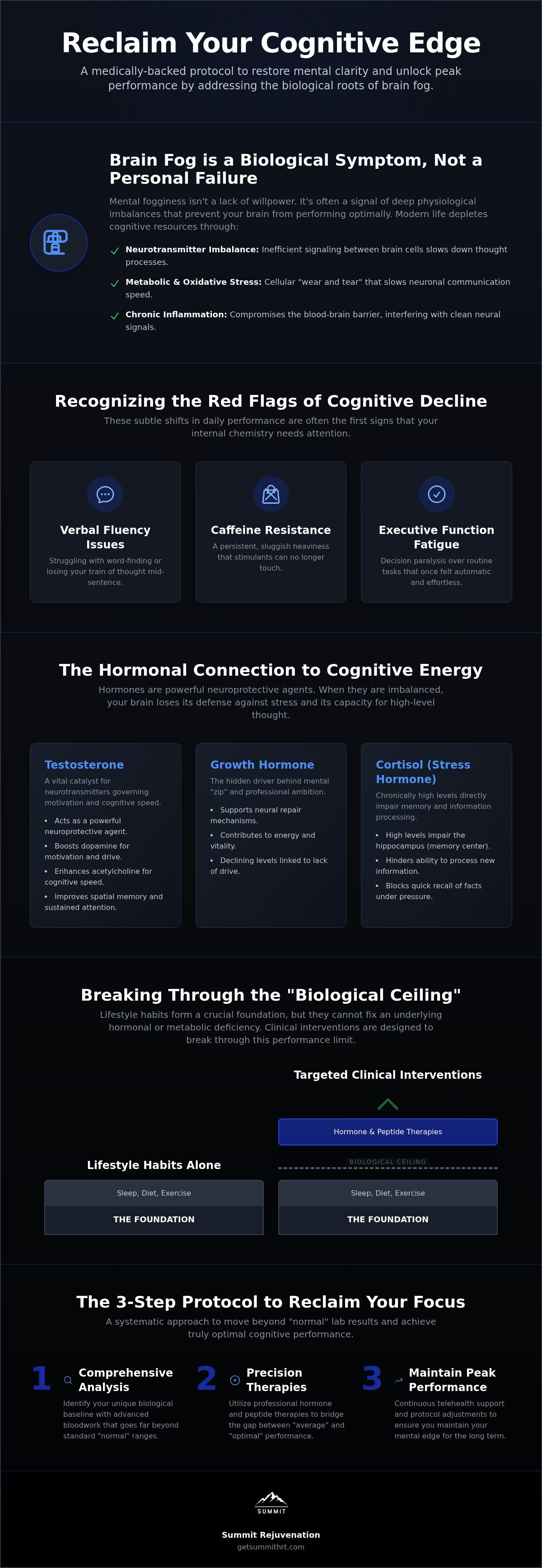
You've likely tried the standard advice. Sleep eight hours. Eat clean. Move daily. Practice mindfulness. These are the "Foundational Four," and they're essential for building a healthy baseline. We fully validate these habits because they provide the raw materials your brain needs to function. However, there's a limit to what lifestyle changes can achieve if your internal chemistry is fundamentally out of balance. We call this the "Biological Ceiling." It's the point where no amount of meditation or clean eating can override a legitimate hormonal deficiency or metabolic stall.
If you're searching for how to improve mental clarity and focus but find yourself hitting a wall despite your best efforts, it's time to look deeper. Clinical intervention isn't a replacement for healthy living. It's an accelerator. When you optimize your biological foundation, your healthy habits suddenly become more effective. You're no longer fighting your own physiology to get through the day. Instead, you're providing your brain with the precise support it needs to maintain a high-performance state.
When Lifestyle Changes Aren’t Enough
Identifying the difference between a motivation issue and a medical issue is crucial for your professional longevity. You might be the "perfect student" of health. You track your macros, hit the gym, and avoid blue light before bed. Yet, the mental sluggishness persists. This disconnect is a major red flag. It suggests that your brain fog isn't a result of poor choices, but a breakdown in cellular communication. Many high-performers ask are peptides good for you when they reach this plateau. Peptides can target specific cellular pathways that lifestyle alone can't reach, helping to restore the cognitive edge you feel you've lost.
The Synergy of Precision Medicine and Routine
The real magic happens when precision medicine meets your daily routine. Clinical support creates a ripple effect throughout your entire life. For example, optimizing your hormone levels often makes your sleep significantly more restorative. You wake up feeling refreshed rather than just "less tired." This creates a sustainable high-performance environment where your brain can thrive. Additionally, targeted vitamin therapy supports mitochondrial function. This ensures your brain cells have the energy required for deep work and complex problem-solving. By combining these medical insights with your existing habits, you'll finally understand how to improve mental clarity and focus on a level that lasts. To explore how plant-based nutraceuticals can support your cognitive health journey, read more about high-quality herbal and mushroom supplements. This collaborative approach turns your health from a chore into a competitive advantage.
Reclaiming your cognitive edge requires more than vague intentions. It demands a structured, data-driven protocol that addresses the biological root causes of fatigue. Learning how to improve mental clarity and focus is a journey of precision, not just persistence. While many generic guides suggest simple lifestyle changes, a professional approach moves through four specific phases to ensure lasting results. This sequence removes the guesswork and places you back in control of your mental energy.
Step 1: Baseline Testing. This is the non-negotiable starting point. We use precision bloodwork to identify exactly where your internal chemistry is falling short.
Step 2: Environmental Audit. You must remove digital friction and inflammatory triggers that deplete your cognitive reserves daily.
Step 3: Biological Optimization. Once we have your data, we address deficiencies through targeted hormone or peptide therapy.
Step 4: Iterative Refinement. We monitor your progress and adjust your protocol based on real-time data to keep your performance at its peak.
The Role of Comprehensive Bloodwork
Standard blood panels often ignore the nuances of cognitive performance. They typically look for disease rather than optimization. To truly understand how to improve mental clarity and focus, we look beyond the basics at free testosterone, IGF-1, and specific thyroid markers. These values reveal the hidden imbalances that cause brain fog even when you're told your results are "normal." The team at summit rejuvenation uses this data to build a personalized strategy tailored to your unique physiology. Bloodwork is the roadmap for cognitive restoration. It tells us exactly where you are and what's required to reach your optimal state.
Peptides and Brain Health
Peptides offer a sophisticated way to support neural processing at a cellular level. Neuro-supportive peptides, such as Semax or Selank, are frequently used to enhance cognitive resilience and reduce the impact of stress on the brain. These compounds can support the production of Brain-Derived Neurotrophic Factor (BDNF), a protein that's essential for the growth and survival of neurons. Unlike generic supplements found on retail shelves, pharmaceutical-grade peptides provide precision and high bioavailability. They act as a catalyst for repair, helping you maintain sharp focus during demanding professional tasks. If you're ready to stop guessing and start optimizing your brain health, you can get started with your comprehensive bloodwork analysis to see which protocols are right for you.
Precision Vitality: How Summit Rejuvenation Restores Cognitive Performance
Our philosophy centers on "Vitality Beyond Hormones." While testosterone and estrogen are critical, true cognitive restoration often requires a broader look at peptides and vitamin therapy. This comprehensive view ensures that your mitochondrial health and neurotransmitter production are fully supported. To discover how Herbal Nutrition can help you optimize your daily intake, you can read more about specialized supplement ranges. You aren't a set of statistics in a database. You're an individual with specific professional demands and personal goals. Our medical providers work alongside you to ensure your protocol is as dynamic as your lifestyle.
Modern high-performers don't have time for the logistical hurdles of traditional medical offices. Our telehealth model brings national-level expertise directly to your door. The process is streamlined for efficiency. You start with comprehensive bloodwork at a local facility, followed by a detailed consultation with a specialist. If treatment is indicated, your medications are shipped directly to your home. Learning about hrt online shows how we've removed the barriers to high-level care, allowing you to focus on your work while we handle the science of your vitality.
Your Personalized Performance Plan
There is no one-size-fits-all solution for mental clarity. Your brain's needs change based on your age, stress levels, and baseline health. This is why we prioritize iterative refinement. We don't just set a protocol and walk away. We monitor your progress and adjust your plan based on data and your subjective feedback. This ongoing support is what differentiates a transactional provider from a dedicated health partner. Maintaining your hormonal and cellular health is a long-term investment in your most valuable asset: your mind. It's time to stop settling for sluggish afternoons and inconsistent recall. You have the tools and the team necessary to understand how to improve mental clarity and focus for the long haul. Reclaim your competitive edge and restore your mental energy today.
Reclaim Your Cognitive Edge and Professional Vitality
Restoring your mental energy is a journey that begins with understanding your unique biology. We've explored how mental clarity is a physiological state dependent on hormonal balance and cellular health. You've learned that while lifestyle habits are vital, they often hit a biological ceiling that only precision medical intervention can break through. By identifying the root causes of brain fog through data, you finally have a clear path for how to improve mental clarity and focus.
You don't have to navigate this process alone. Our team provides the expert guidance and personalized protocols necessary to move beyond feeling just "fine." We simplify the path to optimization by offering Comprehensive Bloodwork Analysis, Telehealth consultations for national convenience, and Customized Hormone & Peptide Protocols tailored specifically to your needs. It's time to stop settling for sluggish performance and reclaim the sharp, decisive mind you deserve. Take the first step toward peak focus with a Summit Rejuvenation consultation and start your restoration today.
Frequently Asked Questions
What are the main causes of sudden lack of mental clarity?
Sudden lack of clarity often stems from acute physiological stressors like systemic inflammation, blood sugar instability, or significant hormonal shifts. While lifestyle factors like high-stress events play a role, your internal chemistry is the primary driver of your cognitive output. If you're looking for how to improve mental clarity and focus, you must look at how these triggers disrupt neurotransmitter synchronization. Identifying these biological root causes is the first step toward reclaiming your edge.
Can low testosterone cause brain fog and difficulty focusing?
Yes, low testosterone is a frequent cause of cognitive sluggishness and decreased executive function. Testosterone acts as a neuroprotective agent that supports dopamine and acetylcholine production in the brain. When levels drop, many men and women experience a persistent mental haze that makes complex decision-making feel exhausting. Restoring these levels through targeted therapy often clears the fog and brings back the professional edge that once felt entirely automatic.
How long does it take to see improvements in focus after starting TRT?
Most patients begin to notice improvements in mental clarity within 3 to 6 weeks of starting Testosterone Replacement Therapy. Cognitive benefits typically appear after the initial stabilization of energy levels. While physical changes may take longer, the restoration of neuroprotective support often provides an earlier sense of mental sharpness. We monitor your progress closely to ensure your protocol is optimized for your specific performance goals throughout this initial period.
Are there specific peptides that help with mental clarity?
Several neuro-supportive peptides are specifically designed to enhance cellular-level focus and cognitive resilience. Peptides like Semax and Selank are used to support Brain-Derived Neurotrophic Factor (BDNF), which promotes neuron health and repair. These pharmaceutical-grade compounds offer a precision approach for those asking how to improve mental clarity and focus. They work by targeting specific pathways that generic supplements simply cannot reach, providing a significant advantage for sustained cognitive performance.
Is brain fog a normal part of aging or a medical symptom?
Brain fog should be viewed as a medical symptom of physiological imbalance rather than an inevitable part of aging. While minor cognitive changes occur over time, persistent sluggishness and difficulty concentrating often indicate underlying hormonal or metabolic deficiencies. We believe that "normal" for your age shouldn't mean settling for lower performance levels. Identifying these biological gaps allows you to reclaim your vitality and maintain a high-functioning mind through every decade.
Can hormone therapy help women with "menopause brain"?
Hormone replacement therapy is highly effective for resolving the "menopause brain" symptoms caused by erratic estrogen and progesterone levels. Estrogen is critical for maintaining synaptic plasticity and neural agility. When these levels fluctuate or decline during perimenopause, cognitive clarity is often the first thing to suffer. Balancing these hormones stabilizes the nervous system and restores the mental sharpness required to navigate both professional and personal responsibilities with complete confidence.
How does sleep quality affect mental clarity on a biological level?
Sleep quality directly impacts the glymphatic system, which is responsible for clearing metabolic waste from the brain. Without deep, restorative sleep, these toxins accumulate and slow down neural processing speeds. This biological waste buildup leads to the heavy, sluggish feeling many experience the next day. Optimizing your hormones often improves sleep architecture, ensuring your brain has the opportunity to repair and reset for peak performance during your working hours.
What blood tests should I get to investigate my lack of focus?
A comprehensive investigation requires looking beyond basic panels at specific biomarkers. We recommend testing for:
Total and Free Testosterone
Estradiol and Progesterone
IGF-1 (Growth Hormone marker)
Full Thyroid Panel (TSH, T3, T4)
Inflammatory markers like CRP
These results provide the data necessary to build a personalized protocol that targets your specific cognitive needs rather than relying on generic solutions that often miss the mark.


Comments