At-Home Hormone Testing for Men: Accuracy, Options, and Next Steps in 2026
What if the answer to your unexplained fatigue and vanishing motivation wasn't hidden in a clinical waiting room, but in a small box delivered to your doorstep? It's frustrating to feel like a shadow of yourself while dreading the cold, impersonal atmosphere of a traditional doctor's office. You want clarity without the hassle, and you've likely considered at-home hormone testing for men as a quick way to bypass the confusion of conflicting symptoms. It is a logical first step for anyone looking to reclaim their edge on a busy schedule.
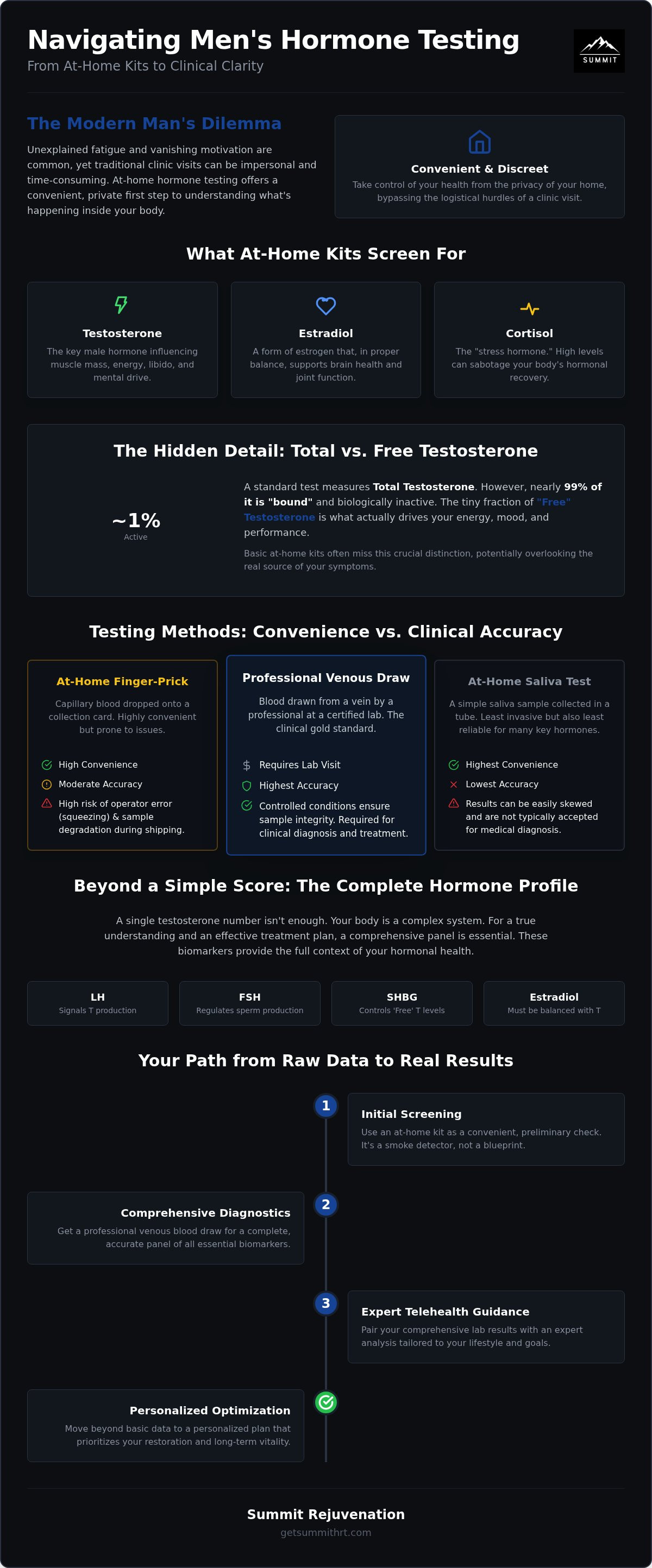
We understand that a simple saliva or finger-prick test feels like a relief, yet many men find themselves more confused by the raw data than they were before. This article will help you discover the reality behind at-home kits and how to transition from a basic screening to a professional, treatment-ready diagnostic plan. We'll explore why nearly 99 percent of testosterone in your body is often biologically inactive, meaning a standard kit might miss the small fraction of "free" testosterone that actually drives your energy and mood.
You will gain a clear understanding of your hormonal health and a direct path to professional care if you need it. We preview the most accurate 2026 testing options and explain how to move beyond basic data into a personalized telehealth partnership that prioritizes your restoration and long-term vitality.
Table of Contents
Understanding At-Home Hormone Testing for Men
In 2026, the path to peak performance often begins on your kitchen table rather than in a cold exam room. At-home hormone testing for men serves as a modern screening tool designed to provide a preliminary look at your internal chemistry. It isn't just about curiosity; it's about proactive health management. These kits typically measure a specific set of biomarkers that dictate your energy, mood, and physical recovery. By identifying imbalances early, you can move from feeling sluggish to taking decisive action toward restoration.
Primary hormones included in these screenings are:
Testosterone: The primary male sex hormone responsible for muscle mass, libido, and bone density. Understanding Testosterone is essential because it influences almost every aspect of male physiology and mental drive.
Estradiol: A form of estrogen that, in the right balance, supports brain health and joint function in men.
Cortisol: Known as the stress hormone, its levels can indicate whether your lifestyle is actively sabotaging your hormonal recovery.
Men are increasingly choosing these options to avoid the logistical hurdles of traditional primary care visits. Between work, family, and personal goals, finding several hours for a clinic visit is a significant barrier. Home testing provides a streamlined entry point into the world of hormone optimization, fitting easily into a busy professional life without the need for complex scheduling.
Why Hormone Privacy Matters
Admitting that you feel less like yourself can be difficult. The stigma surrounding symptoms of "Low T" often prevents men from speaking up during a standard physical. Modern testing logistics offer a level of discretion that traditional clinics cannot match. By allowing you to collect a sample in the privacy of your own home, at-home hormone testing for men lowers the psychological barrier to seeking help. This anonymity empowers you to take the first step toward restoration without the fear of judgment or uncomfortable conversations in a public waiting area.
The Limitations of Mail-In Screening
While convenient, it's vital to recognize that a mail-in kit provides a snapshot rather than a complete diagnostic profile. Hormones fluctuate throughout the day, which is why testing during peak morning hours, typically between 7:00 AM and 10:00 AM, is non-negotiable for accuracy. A single test result is rarely enough to secure a medical prescription for hormone therapy. Most professional protocols require a deeper, more comprehensive analysis to ensure safety and effectiveness. Think of these kits as a high-tech smoke detector; they tell you if there's a potential issue, but they don't provide the full blueprint for the solution.
How At-Home Testosterone Kits Work vs. Professional Lab Draws
Choosing the right collection method is the difference between getting a helpful baseline and receiving a confusing set of numbers. Most at-home hormone testing for men relies on one of three methods: saliva, finger-prick blood spots, or a professional venous draw performed at a local lab. Each offers a different user experience, and the stability of your sample during its journey through the mail is a factor you can't ignore. While the convenience of your own home is tempting, the reliability of the data depends heavily on how the sample is handled before it reaches the technicians.
The cost-to-value ratio varies significantly across testing tiers. Basic kits might only check total testosterone, while premium options include estradiol and SHBG. However, even the most expensive home kit faces the challenge of sample degradation. If a sample sits in a hot mailbox or a sorting facility for several days, the integrity of the biomarkers can shift. When you transition to a professional diagnostic partnership, you ensure that your data is gathered under controlled conditions, giving you the clarity needed for real improvement.
Finger-Prick vs. Venous Blood
Finger-prick tests use capillary blood, which is collected by pricking the side of your fingertip and dropping blood onto a collection card. While convenient, this method carries a higher risk of operator error. Squeezing the finger too hard to produce a drop can damage red blood cells, a process called hemolysis, which may skew your results. In contrast, a venous draw involves a professional phlebotomist taking blood directly from a vein. This method provides a larger, more stable sample that is less prone to environmental contamination. For those moving toward a comprehensive bloodwork analysis, the venous draw remains the gold standard for clinical accuracy.
Saliva Testing: What It Actually Measures
Saliva testing is non-invasive and often used for tracking cortisol or adrenal health. It measures the "free" or bioavailable hormones that are not bound to proteins in your blood. While this sounds ideal, it's a narrow view. A standard Testosterone Levels Test using blood is generally required to see the full picture. Saliva samples can be easily contaminated by food, drink, or even brushing your teeth. Because of these variables, saliva results are rarely sufficient on their own to build a professional testosterone replacement plan. They serve better as a secondary tool for monitoring stress markers rather than a primary diagnostic for male vitality.
Why 'Normal' Results on a Home Test Might Still Mean Low T
It's a common story: you've noticed the brain fog, the lack of drive, and the stubborn weight gain. You finally decide to try at-home hormone testing for men, wait for the results, and see a number that falls squarely in the "normal" range. Yet, you still feel terrible. This disconnect happens because standard laboratory reference ranges are designed to capture a statistical average of the general population, not an individual's peak vitality. These ranges are incredibly broad, often spanning from 300 to 1,000 ng/dL. They include samples from men of all ages and vastly different health statuses, which can make your personal results feel meaningless without the proper context.
Relying solely on a "normal" tag ignores the importance of symptom-to-lab correlation. If your levels are technically within range but you're experiencing every symptom of a deficiency, the number on the page doesn't tell the whole story. We focus on optimal levels: the specific range where your body functions at its best and your symptoms vanish. Discussing the accuracy of testosterone testing is vital here. Standardized assays help us understand that a number is just a starting point for a deeper conversation about your health. It's about how you feel, not just what the paper says.
The Flaw in Age-Adjusted Averages
Most labs don't adjust their "normal" ranges for age, meaning a 25-year-old man is often compared to a 75-year-old man. If a young man has the testosterone levels of someone three times his age, he'll feel the effects of decline even if he's technically "in range." This creates a gap between your chronological age and your biological hormonal age. Your chronological age is the years on your calendar, while your biological hormonal age reflects your endocrine health.
Bioavailability: The Hidden Factor
Total testosterone is only half the story. Most of the testosterone in your blood is bound to proteins like Sex Hormone Binding Globulin (SHBG), making it biologically inactive. Think of total testosterone as a warehouse; if the doors are locked by SHBG, your body can't use the supplies. Many options for at-home hormone testing for men miss these markers. Without measuring free testosterone and SHBG, you're looking at a reservoir without knowing if it's actually reaching your cells.
The Essential Biomarkers for a Complete Male Hormone Profile
A single number on a screen doesn't offer the full story of your health. If you're using at-home hormone testing for men to decide if you need treatment, you must look beyond total testosterone. A complete profile acts as a roadmap for your endocrine system, showing not just where your levels are, but why they are there. This depth is what separates a simple screening from a professional diagnostic plan that ensures both results and safety. To build a treatment-ready profile, you need to measure a specific set of biomarkers that work in tandem.
The "must-have" markers for any man considering hormone therapy include:
Luteinizing Hormone (LH): The primary signal from the brain to the testes to produce testosterone.
Follicle Stimulating Hormone (FSH): The hormone responsible for sperm production and fertility.
Estradiol: The primary form of estrogen in men, which must be balanced to maintain heart, bone, and brain health.
Prostate Specific Antigen (PSA): A vital safety marker used to monitor prostate health before and during therapy.
Hematocrit: A measurement of red blood cell concentration to ensure blood viscosity remains in a safe range.
Hormonal Regulators and Feedback Loops
LH and FSH are the messengers of your hormonal system. LH tells your body to produce testosterone, while FSH is critical for fertility awareness and sperm production. Understanding these signaling markers helps determine if your low levels stem from a production issue in the testes or a communication breakdown in the brain. This level of detail aligns with the Summit Rejuvenation philosophy of precision, where we focus on the root cause of your symptoms rather than just masking them with a generic solution.
Metabolic and Safety Markers
Safety is just as important as vitality. Measuring Estradiol is necessary because testosterone naturally converts to estrogen; too much or too little can lead to mood swings, water retention, or joint pain. We also monitor your metabolic health through liver and kidney function tests, as these organs are responsible for hormone metabolism. A CBC (Complete Blood Count) is vital for TRT monitoring because it tracks your hematocrit levels to prevent blood from becoming too thick. Utilizing a comprehensive bloodwork analysis prevents side effects by catching subtle shifts in your biology before they become problems. If you're ready to move beyond basic kits to a professional standard of care, you can start your comprehensive analysis here.
Beyond the Test: Personalized Hormone Optimization with Summit Rejuvenation
While at-home hormone testing for men provides a valuable starting point, a number on a lab report isn't a solution. It's a signal. Many men find themselves stuck with results they don't know how to interpret or, worse, with "normal" scores that don't explain why they still feel exhausted. This is where Summit Rejuvenation steps in. We act as the bridge between your initial curiosity and a total physical transformation. Our process isn't just about reading bloodwork; it's about translating that data into a life-changing strategy.
Our team understands that you aren't just looking for a test kit. You're looking for restoration. By moving beyond the screening phase, you enter a professional partnership where your symptoms are the priority. We don't just hand you a report and wish you luck. We provide a clear, step-by-step path to reclaiming your drive and vitality through expert-led care that prioritizes your unique biological needs.
The Telehealth Advantage in 2026
Accessing high-level expertise no longer requires a commute or a seat in a crowded waiting room. The rise of online TRT allows you to consult with specialists who focus specifically on male hormone optimization from the comfort of your home. During your telehealth consultation, we review your comprehensive bloodwork together. This isn't a one-way lecture; it's a collaborative session where we discuss your lifestyle, goals, and symptoms. We take the time to answer your questions and build a plan that fits your specific biology, ensuring you feel heard and supported throughout the entire journey.
Direct-to-Home Care Logistics
Once your personalized plan is in place, the convenience continues with direct-to-home medication delivery. We manage the logistics of your treatment with the same precision we apply to your diagnostics. Your prescribed medications are shipped securely and reliably to your door, removing the need for monthly pharmacy trips. The care doesn't stop with the first delivery, either. Maintaining "Optimal" levels requires ongoing support and regular follow-up testing. We monitor your progress closely, adjusting your plan as your body responds to ensure you stay in the peak performance zone. You've already recognized that something needs to change. Now is the time to take the definitive first step toward reclaiming your edge and living with the vitality you deserve.
Take Control of Your Hormonal Future
You've explored how at-home hormone testing for men serves as a convenient entry point into understanding your internal health. However, you also know that raw data is only useful when it's paired with professional interpretation and a complete biomarker profile. Moving from a basic screening to a diagnostic plan ensures you don't settle for broad "normal" ranges that ignore your persistent symptoms. True vitality requires a shift from simple data collection to a dedicated, expert-led partnership.
Summit Rejuvenation provides the bridge to your best self through personalized physician-led treatment plans and convenient telehealth consultations. We prioritize your restoration by delivering direct-to-home medications and providing the ongoing monitoring necessary for long-term success. You don't have to navigate the confusion of conflicting lab results or clinical coldness alone. Our team is here to guide you through every phase of your optimization journey.
Schedule your comprehensive bloodwork and reclaim your vitality with Summit Rejuvenation. Your journey to feeling like yourself again starts with a single, decisive step toward expert care. We're ready to help you reclaim your edge and live with the clarity and energy you deserve.
Frequently Asked Questions
Is at-home hormone testing as accurate as a doctor's office?
At-home kits are generally considered less precise than a venous blood draw performed in a professional lab setting. While many kits use CLIA-certified laboratories to ensure quality, finger-prick and saliva samples are more susceptible to environmental factors and operator error. These tests serve as an excellent preliminary screening tool, but they shouldn't replace the deep diagnostic accuracy provided by a clinical blood draw when you're ready to begin a formal treatment plan.
How much does at-home hormone testing for men typically cost?
The cost for at-home hormone testing for men in 2026 typically ranges from $70 to $350 depending on the complexity of the panel. Basic testosterone-only tests from providers like Everlywell or Labcorp OnDemand start around $49 to $69. More comprehensive options that include biomarkers like cortisol, DHEA, and estradiol can reach up to $249 or more. These prices reflect the kit and lab processing but rarely include a professional consultation to interpret the data.
What is the best time of day to take a testosterone test at home?
You should collect your sample during peak morning hours, specifically between 7:00 AM and 10:00 AM. Testosterone levels are naturally at their highest during this window and fluctuate significantly as the day progresses. Testing later in the afternoon can result in artificially low readings that don't accurately reflect your body's true production capacity. Consistency in timing is vital if you plan to compare results over several months.
Can I get a TRT prescription based on an at-home kit result?
A prescription for testosterone replacement therapy is rarely granted based solely on an at-home kit result. Professional medical protocols require a more comprehensive analysis, usually involving a venous blood draw, to ensure patient safety and dosage accuracy. While your home kit identifies a potential need, a licensed provider will typically require a deeper diagnostic profile and a telehealth consultation before developing a personalized, treatment-ready plan for your vitality.
Do home hormone tests check for more than just testosterone?
Many modern kits offer panels that measure markers beyond just total testosterone, such as estradiol, cortisol, and SHBG. For example, some advanced health tests in 2026 include DHEA and thyroid markers to provide a broader view of your endocrine health. Choosing a kit that measures free testosterone is particularly helpful, as it reveals the small fraction of the hormone your cells can actually use for energy and muscle recovery.
How long does it take to get results back from a mail-in kit?
Most users receive their results within 2 to 5 business days after the laboratory receives the sample. This timeline depends on the shipping method and the specific lab's processing volume. While the wait is relatively short, you should account for the time it takes for your kit to arrive in the mail and the time required for you to ship your sample back to the facility for analysis.
What should I do if my home test results show low testosterone?
If your results indicate low levels, the next step is to transition from a simple screening to a professional diagnostic partnership. You should schedule a comprehensive bloodwork analysis that looks deeper into your hormonal regulators and safety markers. This data allows a specialist to determine the root cause of your symptoms and build a personalized treatment plan that moves you from a "normal" range to your optimal state of vitality.
Are at-home hormone tests covered by insurance in 2026?
Most at-home hormone testing for men is not covered by traditional health insurance plans in 2026. These tests are typically viewed as elective screenings rather than medically necessary diagnostics. However, many providers allow you to use HSA or FSA funds to cover the out-of-pocket costs. It's always best to check with your specific insurance provider or account administrator to confirm which testing kits qualify for reimbursement under your current plan.


Comments