How to Talk to Your Doctor About TRT: A Guide to Self-Advocacy in 2026
Updated: Aug 27
You have spent months feeling like a shadow of your former self, yet when you finally mention your persistent fatigue and brain fog, your physician glances at a lab report and declares you are "perfectly normal." It is a disheartening moment that many men face when their subjective symptoms collide with rigid clinical ranges. You know your body better than a chart does, and you deserve a partner in health who listens. Learning how to talk to your doctor about trt is the essential first step in reclaiming your vitality and moving from simply surviving to truly thriving.
We agree that being told you're fine when you clearly feel "off" is a frustrating experience that often leads to unnecessary anxiety. This guide promises to equip you with the exact roadmap needed to prepare for your visit, interpret your lab results with precision, and challenge outdated perspectives. We'll explore the crucial difference between total and free testosterone, the impact of the 2026 FDA labeling updates on safety perceptions, and how to find a provider who prioritizes optimization over standard reference ranges. You'll gain the confidence to lead a transparent, results-driven conversation that ensures your hormonal health is taken seriously.
Table of Contents
Preparing for the Conversation: Tracking Symptoms and Impact
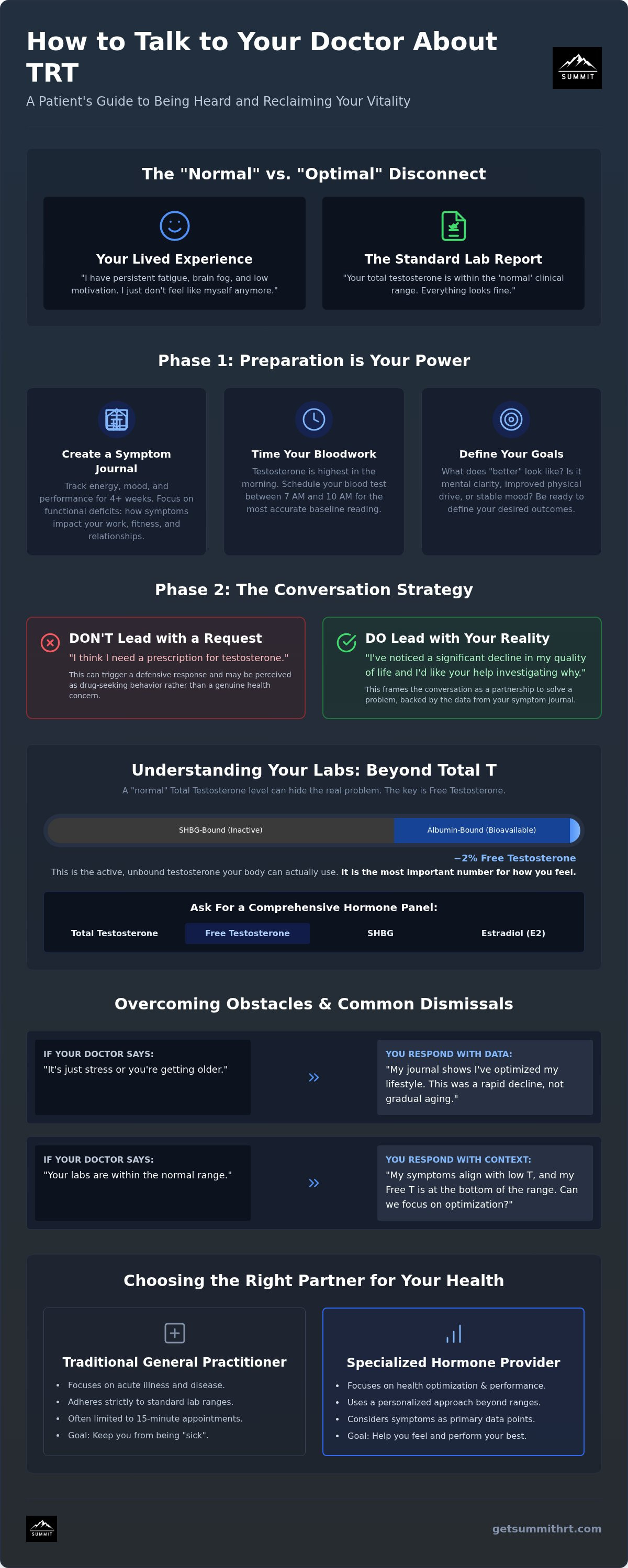
Entering a 15-minute medical consultation without data is like a pilot flying without a dashboard. You need a symptom journal to anchor the discussion, transforming vague complaints into clinical evidence. Most general practitioners are trained to look for acute illness rather than sub-optimal performance. By documenting your daily energy levels for at least four weeks, you provide a narrative that a single lab test cannot capture. When you research Testosterone (medication), you'll see it is used to treat specific physiological deficits; your journal proves those deficits exist in your daily reality.
Timing is a critical logistical factor. You must request your bloodwork for a window between 7 AM and 10 AM. Testosterone levels are diurnal, meaning they peak in the early morning and drop significantly as the day progresses. Testing in the afternoon may lead to an inaccurate "low" reading that doesn't reflect your peak potential, while a morning test provides the gold standard baseline for a diagnosis. Additionally, gather your family history regarding metabolic health or cardiovascular issues. These data points help your doctor understand your genetic predisposition toward hormonal shifts and provide a broader context for your care.
The Functional Deficit Framework
Essential Questions to Ask Yourself Before the Visit
Clarity of purpose is your best tool for self-advocacy. Preparation is the foundation of how to talk to your doctor about trt so you aren't caught off guard by standard dismissals. Before stepping into the clinic, ask yourself exactly when you last felt like your optimal self. Was it two years ago or five? Determine if your symptoms are persistent or if they appear to be cyclical. Finally, define your desired outcomes. Are you strictly looking for a specific lab number, or is your primary goal the reclamation of your mental clarity and physical drive? Knowing these answers allows you to guide the consultation with confidence and professional precision.
The Conversation Strategy: Moving from Requests to Results
Don't walk into your appointment and lead with a request for a prescription. This approach often triggers a defensive response from general practitioners who may perceive it as drug-seeking behavior rather than a legitimate health concern. Instead, anchor the conversation in your observed reality. Mastering how to talk to your doctor about trt requires a shift from demanding a solution to presenting a problem that needs solving. Start by stating that you've noticed a significant decline in your quality of life. Mention that despite your best efforts with lifestyle changes, your energy, focus, and drive haven't returned to their baseline.
When you discuss your symptoms, don't limit the scope to physical changes. Hormonal health is deeply intertwined with mental clarity and emotional stability. Describe your brain fog and sudden irritability as clinical symptoms rather than personality shifts. This creates a bridge between your physical state and your mental well-being, forcing a more holistic diagnostic approach. Request a comprehensive hormone panel that includes more than just total testosterone. You need to see free testosterone, SHBG, and estradiol to understand the full picture. Physicians often rely on the AUA clinical guidelines to define deficiency; referencing these standards can help justify your request for a deeper look at your metabolic health.
Phrasing for Success: Scripts for Patients
Use language that emphasizes partnership and objective discovery. You might say, "I've been researching hormonal optimization for my specific symptoms, and I want to rule out imbalances as a cause for my persistent fatigue." This positions you as an informed patient seeking clarity. Ask about the long-term implications of your current state. Use questions like, "How will optimizing my levels affect my cardiovascular and bone health over the next decade?" This framing shifts the focus from a "quick fix" to a long-term health strategy. If you're ready to see where your levels actually stand, you can start with comprehensive bloodwork analysis to get the full, data-backed picture of your vitality.
Managing the Drug-Seeking Stigma
The stigma surrounding hormone therapy is often rooted in a misunderstanding of its purpose. To navigate this, always emphasize health restoration over performance enhancement. You aren't looking for an unfair advantage; you're looking to return to your natural, healthy baseline. Discussing TRT as a medical necessity for metabolic health is a cornerstone of how to talk to your doctor about trt effectively. Be transparent about your research and why you're concerned about your specific symptoms. When you demonstrate that your goal is longevity and disease prevention, you move the conversation away from the "locker room" and into the clinical space where it belongs.
Navigating Lab Results: Beyond the 'Normal Range' Myth
Most patients feel a sense of relief when they finally see their lab results, but a single data point rarely tells the whole story. Total testosterone represents the total amount of the hormone in your bloodstream, yet a significant portion is bound to proteins and unavailable for immediate use. Free testosterone is the "active" fraction that actually drives your vitality, mental clarity, and muscle recovery. If your total levels look acceptable but you still feel symptomatic, your free testosterone is likely the culprit. This distinction is central to how to talk to your doctor about trt; you aren't just looking for a number, you're looking for biological functionality.
Sex Hormone Binding Globulin (SHBG) acts as a molecular sponge, soaking up testosterone and preventing it from reaching your tissues. High SHBG levels can leave you with deficient free testosterone even if your total number appears healthy. To ensure a precise clinical diagnosis, standard protocols generally require two separate tests, typically performed between 7 AM and 10 AM. This repetition confirms that a low reading isn't just a temporary dip caused by a single night of poor sleep or acute stress, but a persistent hormonal state that requires intervention.
What Your 'Low-T' Labs Are Actually Telling You
Your bloodwork should include Luteinizing Hormone (LH) and Follicle-Stimulating Hormone (FSH) to identify the source of the deficiency. These markers help determine if your issue is primary, where the testes aren't producing, or secondary, where the brain isn't sending the proper signals. Monitoring Estradiol is also vital, as an imbalance in this estrogen marker can cause mood swings or water retention regardless of your testosterone levels. For a deeper dive into these specific markers, read What Your Low-T Labs Are Actually Telling You to understand the mechanics of hormonal balance.
Why 'Normal' Isn't Always 'Healthy'
The "normal" reference range, which often spans from approximately 264 to 916 ng/dL, is a statistical aggregate that includes men from age 18 to 80, regardless of their metabolic health or lifestyle. A 30-year-old with the testosterone levels of an 80-year-old might technically be "in range," but he certainly isn't healthy. The Reference Interval is a statistical average derived from a specific lab's population, not a validated medical standard for individual health or vitality.
When you're learning how to talk to your doctor about trt, emphasize that you aren't comparing yourself to a broad population average; you're comparing your current state to your own historical baseline. If you fall into the "low-normal" bracket but suffer from persistent, life-altering symptoms, you have a legitimate case for treatment. Effective advocacy means refusing to accept a statistical average as a substitute for your personal well-being and long-term health optimization.
Overcoming Obstacles: What to Do if Your Doctor Says 'No'
You may arrive at your appointment with a detailed symptom journal and a firm grasp of your data, yet still face a wall of resistance. This experience is often called medical gaslighting. It occurs when a provider dismisses your subjective reality in favor of a rigid, statistical average. Common dismissals include blaming your fatigue on "just stress" or telling you that "you're just getting older." Understanding how to talk to your doctor about trt involves knowing how to pivot when these obstacles arise. If a provider refuses to order the comprehensive bloodwork you need, professionally request that they document their refusal in your medical record. This request often prompts a shift in the provider's stance, as it creates a formal account of a potentially overlooked diagnostic step.
A "normal" lab result is the most frequent reason for a treatment denial. However, a result that falls within a statistical range does not mean it is healthy for your specific physiology. If your current provider refuses to look beyond a "normal" lab result, it is time to seek an expert second opinion from specialists who focus on restoration rather than just the absence of disease. You deserve a partner who views your health through the lens of optimization, not just a lack of acute illness.
Rebutting the 'Age' Argument
When a doctor says you are simply experiencing the natural decline of aging, you must counter with a focus on vitality. State clearly that you want to age with high function, not just accept a lower quality of life. Point to the long-term clinical risks associated with untreated hypogonadism, such as osteoporosis and metabolic syndrome. Ask the provider for the specific clinical reason why a 35-year-old man should be expected to thrive with the hormone levels of an 80-year-old. This framing forces the conversation away from vague generalizations and back toward your individual health needs and longevity goals.
When to Walk Away from a Provider
There is a significant difference between a primary care physician and a hormone specialist. If your doctor is unaware of the 2026 FDA labeling changes or the safety data from the TRAVERSE trial, they are likely not current on hormone optimization research. Signs that it is time to find a new provider include a lack of interest in your specific symptoms or a refusal to discuss "optimal" ranges. Mastery of how to talk to your doctor about trt also means knowing when a partnership has reached its limit. You are the primary stakeholder in your health, and you have every right to find a provider who treats you as a collaborative partner in your own wellness journey.
Choosing the Right Partner: The Case for Specialized Care
While mastering how to talk to your doctor about trt is a vital skill for any patient, you may eventually find that a general practitioner’s scope is simply too broad to provide the nuanced care you require. General practitioners are often focused on acute illness and broad population health, which can lead to a "wait and see" approach that leaves your symptoms unaddressed. A specialized clinic, however, views your health through the lens of optimization and restoration. These specialists understand that a lab result at the bottom of a "normal" range is a clinical opportunity for improvement rather than a reason to dismiss your concerns. They prioritize your subjective experience alongside your data, ensuring that your treatment plan is as unique as your physiology. This personalized focus is a hallmark of ZenVana Medical and Wellness Group LLC, which integrates mental health support with physical wellness to ensure a comprehensive recovery.
When selecting a clinical partner, look for a provider that emphasizes three pillars: comprehensive baseline labs, personalized dosing, and rigorous ongoing monitoring. True hormone optimization is not a "set it and forget it" process. It requires a dedicated partner who tracks your progress, adjusts your protocol based on your feedback, and remains current on the latest clinical research. This level of attentive, traditional care ensures that your journey toward vitality is both safe and effective.
The regulatory landscape in 2026 has solidified the role of telehealth in hormone optimization. With the DEA and HHS extending telemedicine flexibilities through December 31, 2026, licensed practitioners can continue to prescribe testosterone via secure audio-video visits. This model allows you to discuss sensitive symptoms from the privacy and comfort of your own home, removing the "waiting room" anxiety often associated with local clinics. You gain access to national leaders in hormone therapy regardless of your physical location. The process is streamlined and efficient; from your initial consultation to the direct delivery of medications to your door, every step is designed to respect your time and privacy. To learn more about this modern approach, read HRT Online: How to Access Professional Hormone Therapy from Home.
Summit Rejuvenation: Precision Vitality
At Summit Rejuvenation, we believe that comprehensive bloodwork analysis is the only foundation for a successful health transformation. We don't guess; we use precision data to create a roadmap that is tailored specifically to your metabolic and hormonal needs. Our "Dedicated Partner" model ensures that you are never just a patient in a system. We prioritize your education, explaining the "why" behind every recommendation so you can truly own your health journey. We bridge the gap between where you are and where you want to be, providing the expert guidance you need when learning how to talk to your doctor about trt leads you toward specialized care. It is time to move beyond survival and start your restoration. Start your journey with a comprehensive bloodwork analysis at Summit Rejuvenation today.
Reclaiming Your Vitality Through Informed Advocacy
You now possess the tools to transform your healthcare experience from a passive consultation into a proactive partnership. By documenting your functional deficits and understanding the nuances of free testosterone, you can navigate the medical landscape with clarity. Understanding how to talk to your doctor about trt ensures that your subjective symptoms are never sidelined by a statistical average. You deserve a healthcare model that prioritizes your restoration and long-term metabolic health.
If you're tired of being told your labs are "fine" while you continue to struggle, it's time to work with specialized experts in hormone optimization. Our team provides the precision data and personalized care required to reclaim your drive. Schedule your comprehensive telehealth consultation and bloodwork with Summit Rejuvenation to experience the convenience of direct-to-home shipping and expert guidance. Your journey toward a more vibrant, high-performing self starts with a single, decisive step. You have the power to change your trajectory today.
Frequently Asked Questions
Can I get TRT from my regular family doctor?
Yes, you can, but it is often a difficult path. Most family doctors focus on general health and may only prescribe if you are severely deficient according to rigid lab ranges. They often lack the specialized training in hormone optimization required to manage dosing for vitality. If you want a partner who understands the nuance of "optimal" versus "normal," a specialized clinic is usually a more effective route for long-term success.
What should I do if my testosterone levels are 'normal' but I still have symptoms?
You should seek an expert second opinion immediately. "Normal" ranges are statistical averages that include a broad population, including the sick and elderly. If your total testosterone is in-range but your free testosterone is low, you will likely remain symptomatic. A specialist will look at your functional health and symptoms rather than just a number on a page, helping you determine if optimization is necessary for your specific life goals.
Is it better to see a urologist, an endocrinologist, or a specialized TRT clinic?
Specialized TRT clinics often provide the most comprehensive care for vitality and restoration. Urologists and endocrinologists are highly skilled but often focus on pathology, such as tumors or severe disease, rather than lifestyle optimization. A specialized clinic is dedicated specifically to hormone therapy, offering more frequent monitoring, personalized dosing, and a deeper understanding of how to talk to your doctor about trt to achieve peak performance.
How do I ask my doctor for a testosterone blood test specifically?
Lead with your symptoms and request a "comprehensive hormone panel" to rule out metabolic issues. State clearly that you've noticed persistent fatigue, brain fog, and decreased recovery despite healthy lifestyle habits. By asking for a broad panel rather than just a single test, you position the request as a diagnostic necessity. This approach is a core part of how to talk to your doctor about trt effectively while maintaining a collaborative relationship.
Will my insurance cover TRT if I talk to my doctor first?
Insurance coverage typically depends on having two separate lab results showing levels below a very low threshold, often 300 ng/dL. Even if you talk to your doctor, many plans won't cover treatment if you are in the "low-normal" range, despite being symptomatic. Many patients choose self-pay models at specialized clinics to avoid these restrictive hurdles and ensure they receive a customized protocol that isn't dictated by insurance company policies.
What are the specific blood markers I should ask my doctor to test?
You should request Total Testosterone, Free Testosterone, SHBG, Estradiol, LH, and FSH. These markers provide a complete picture of your hormonal health. Total testosterone alone is insufficient because it doesn't show how much hormone is actually available for your body to use. Including LH and FSH helps identify if the issue is primary or secondary, while SHBG and Estradiol help explain how your body is processing and binding these hormones.
How do I explain my low libido to my doctor without feeling embarrassed?
Treat it as a clinical symptom rather than a personal failing. Use professional language like "decreased libido" or "loss of morning erections" to keep the conversation focused on physiology. Doctors view these as vital health markers, much like blood pressure or heart rate. Frame it as a sudden, persistent change that is affecting your quality of life, which helps your provider recognize it as a legitimate medical concern requiring investigation.
What happens if my doctor refuses to test my testosterone levels?
Ask the doctor to document their refusal and the clinical reasoning behind it in your medical record. This formal request often encourages a provider to reconsider their stance to avoid potential liability for missed diagnoses. If they still refuse, it is a clear sign that you need a new provider who respects your concerns. You have the right to access your own health data through a specialized hormone optimization partner who prioritizes your well-being.


Comments