Hormone Testing for TRT: The 2026 Comprehensive Guide
What if your "normal" lab results are actually the reason you still feel exhausted, foggy, and disconnected from your best self? It's a common frustration to have a physician glance at a standard blood panel and tell you everything is fine, even when your quality of life suggests otherwise. You deserve more than a shrug and a reference range designed for the average population rather than your specific biological needs. Learning how to get your hormones tested for trt is the critical first step in reclaiming the energy and focus you've lost.
We believe your health should be proactive, not just a reaction to deficiency. You shouldn't have to manage a maze of clinical visits or settle for vague answers about your own body. This comprehensive 2026 guide is designed to empower you with clarity. You'll discover exactly how to handle the hormone testing process, decode your results, and bridge the gap between "normal" lab numbers and optimal vitality. We'll walk through the essential biomarkers to request, the latest telehealth flexibilities that make screening easier than ever, and the specific steps required to transition from a confusing lab report to a professional treatment plan that actually works.
Table of Contents
Why Hormone Testing is the Essential First Step for TRT
You can't fix what you haven't measured. Before you start any protocol for Androgen replacement therapy, you need a clear clinical baseline. This isn't just about checking a box for a prescription. It's about building a diagnostic map that ensures your treatment is safe, effective, and tailored to your specific biology. While it's tempting to look at a list of symptoms and assume you know the answer, self-diagnosis is medically unsafe. Many conditions, from thyroid dysfunction to simple vitamin deficiencies, can mimic the symptoms of low testosterone. Understanding how to get your hormones tested for trt ensures you are treating the root cause rather than just chasing shadows.
Think of your bloodwork as the blueprint for your restoration. A comprehensive bloodwork analysis provides the data your provider needs to move you from a state of survival to one of peak performance. Without these numbers, any attempt at trt therapy is just guesswork. We prioritize your understanding of these metrics so you can become a partner in your own care.
The Problem with "Normal" Lab Results
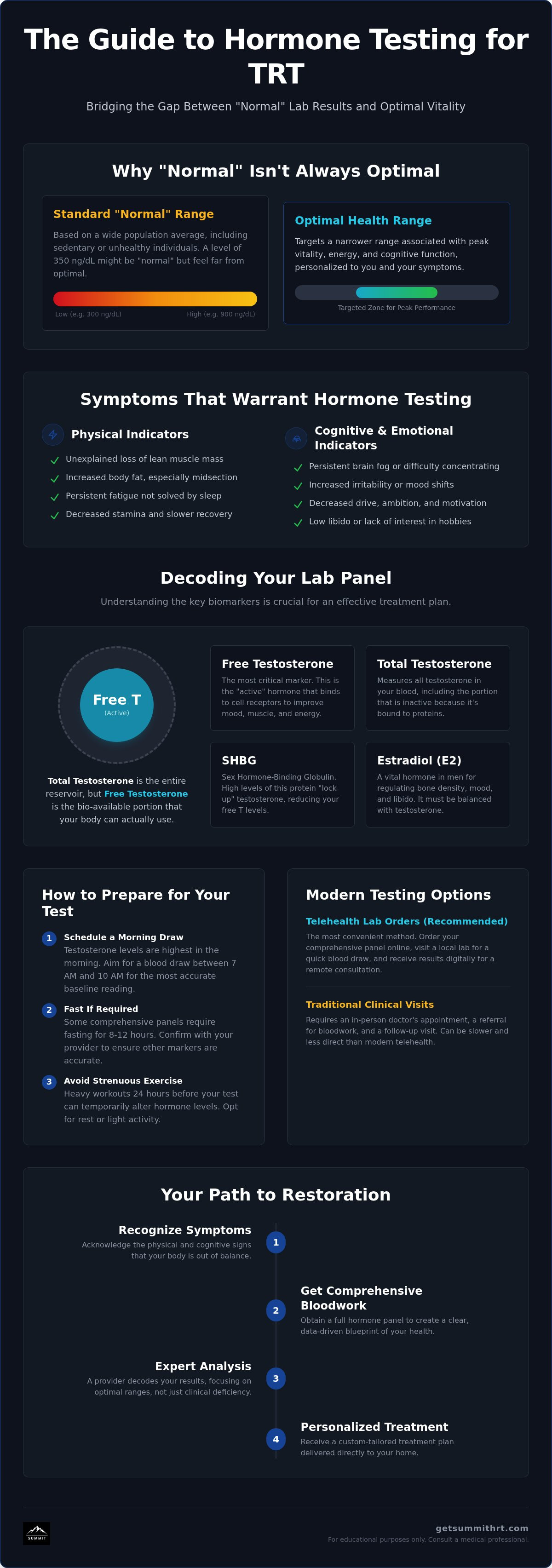
Standard lab ranges are often misleading. Most laboratories calculate "normal" based on a broad bell curve of the people who visited that specific lab recently. This population often includes individuals who are aging, sedentary, or dealing with chronic illness. If you are 35 years old and your levels match the average of an 80 year old, you might still fall within the standard range of 300 to 900 ng/dL. Your doctor might say you're "fine," but you don't feel fine. We focus on optimal health ranges rather than just clinical deficiency. It's vital to treat the person, not just the numbers on a piece of paper. If you're searching for how to get your hormones tested for trt, you likely already know that your current "normal" isn't working for you.
Identifying Symptoms That Warrant a Test
Your symptoms are the "why" behind the testing process. They are the signals your body sends when the internal machinery is out of balance. If you recognize these indicators, it's time to seek a professional analysis.
Physical Indicators:
Unexplained loss of lean muscle mass despite consistent training.
Increased body fat, particularly around the midsection.
Persistent fatigue that isn't solved by a full night of sleep.
Decreased physical stamina or slower recovery times.
Cognitive and Emotional Indicators:
Persistent brain fog or difficulty concentrating on complex tasks.
Increased irritability or sudden shifts in mood.
A noticeable decrease in drive, ambition, and general motivation.
Low libido or a lack of interest in activities you once enjoyed.
Recognizing these signs is the first step toward reclaiming your vitality. Testing provides the objective data to confirm what your body is already telling you.
Decoding Your Lab Panel: Total vs. Free Testosterone and Beyond
A single number on a lab report rarely tells the whole story. When you research how to get your hormones tested for trt, you'll likely see "Total Testosterone" mentioned most frequently. Total Testosterone represents the entire reservoir of the hormone circulating in your bloodstream. However, much of that hormone is bound to proteins, making it unavailable for your cells to use. This is why a Testosterone Levels Test must also measure Free Testosterone. Free Testosterone is the "active" portion that actually binds to receptors to improve your mood, muscle mass, and energy.
Think of Sex Hormone-Binding Globulin (SHBG) as a delivery truck. While it transports hormones through your system, it can also lock them up. If your SHBG levels are too high, your Total T might look "normal" while your Free T is dangerously low. Understanding how to get your hormones tested for trt properly means insisting on a comprehensive panel rather than a single marker. We look at the relationship between these markers to understand your true hormonal status and create a plan for restoration.
The Critical Secondary Markers
A safe protocol requires looking beyond just testosterone. Estradiol (E2) is often misunderstood; it's a vital hormone for men that regulates bone density and brain health. However, if it's out of balance, you may experience side effects like irritability or water retention. We also monitor Albumin, another protein that binds to testosterone, to calculate your bioavailable levels. Additionally, measuring Luteinizing Hormone (LH) tells us if your brain is currently signaling your body to produce its own testosterone. This helps determine if your issue is primary or secondary hypogonadism, which dictates the direction of your care.
Safety Markers You Cannot Ignore
Restoring your vitality should never come at the expense of your long-term health. Before starting any therapy, establishing a baseline for your Prostate-Specific Antigen (PSA) is essential for monitoring prostate health. We also require a Complete Blood Count (CBC) to check your hematocrit and hemoglobin. Testosterone can increase red blood cell production, so we monitor these levels to ensure your blood viscosity stays within a safe range. Finally, we assess liver and kidney function to ensure your metabolic system is prepared to support hormone optimization. Taking these precautions is why a professional TRT protocol is so much more effective and sustainable than self-treatment.
Where to Get Tested: Comparing Local Clinics and Telehealth Lab Orders
Deciding where to begin your journey is a pivotal choice. Many men start with their family doctor, but the traditional primary care route often leads to frustration. General practitioners may resist ordering a full panel, often sticking to a basic screening that misses the nuances of your health. This resistance is a primary reason why men seek specialized guidance on how to get your hormones tested for trt with more precision. You shouldn't have to plead for the data you need to understand your own body.
Brick-and-mortar clinics offer a physical space for your care. These specialized centers provide in-person interaction, which can feel reassuring for some. However, they often come with higher overhead costs and the inconvenience of commuting to a specific location. For those who value both expertise and efficiency, the telehealth model has become the gold standard. It offers a level of discretion that traditional clinics can't match. You won't find yourself sitting in a crowded waiting room; instead, your health journey remains private and professional.
With telehealth, the process is decentralized for your benefit. You receive a lab order digitally, visit a nearby draw station like Quest or Labcorp, and then consult with a provider from the comfort of your home. This approach maintains your privacy and allows you to fit your health optimization into a busy life without sacrificing the quality of your care.
The Convenience of Telehealth Lab Integration
Modern hrt online models have completely streamlined the diagnostic phase. Once you've decided to move forward, you don't have to wait weeks for an appointment. You can select a lab location that fits your daily schedule, making the blood draw a quick stop on your way to work. Digital result delivery also removes the friction of waiting for a phone call or a letter in the mail. You get your data quickly, allowing you to move toward your restoration plan without unnecessary delay.
Cost Considerations for Hormone Bloodwork
Understanding the financial side of testing is just as important as the clinical side. It's a reality that insurance companies often deny coverage for comprehensive hormone panels, labeling them as wellness or elective rather than medically necessary. This can lead to unexpected bills if you go through a traditional doctor. Specialized clinics typically offer transparent, cash-pay pricing for their bloodwork. By choosing a transparent model for how to get your hormones tested for trt, you avoid the administrative hurdles of insurance. Investing in a full panel now saves you money in the long run by preventing the trial and error of improper dosing. When asking Do you need testosterone therapy?, having the right numbers is the only way to get a definitive, cost-effective answer.
Preparation Guide: How to Ensure Accurate Hormone Test Results
Your bloodwork is only as good as the conditions under which it's collected. If you don't prepare correctly, you risk receiving skewed data that leads to an ineffective protocol. Understanding how to get your hormones tested for trt requires more than just showing up at a lab; it demands a disciplined approach to the 24 to 48 hours preceding your appointment. We want to ensure your results reflect your true physiological state, not a temporary dip caused by poor preparation.
The primary factor in test accuracy is timing. Your body follows a diurnal rhythm, which means testosterone levels naturally peak in the early morning, specifically around 8:00 AM. As the day progresses, these levels can drop significantly, sometimes by as much as 20% to 30% in younger men. Testing in the afternoon might result in a false low reading that doesn't accurately represent your hormonal health. By capturing your levels at their peak, we establish a reliable baseline for your optimization journey.
The Morning Requirement and Fasting
To ensure your results are valid for clinical diagnosis, you must schedule your draw between 7:00 AM and 10:00 AM. This window is the standard required by most medical providers to confirm a consistent peak. You should also maintain a strict 10 to 12 hour fast before your appointment. While testosterone itself isn't always affected by a meal, other markers in a comprehensive panel, such as glucose and lipids, are highly sensitive to food intake. Drink plenty of water during this fasting period. Staying hydrated makes the blood draw easier and prevents the slight concentration of red blood cells that occurs with dehydration.
Lifestyle Factors That Skew Results
Your activities in the days leading up to the test can temporarily suppress or inflate your numbers. Avoid intense physical exertion, especially heavy leg days or high-intensity cardio, for at least 48 hours before your test. Intense exercise causes temporary hormonal shifts and muscle damage that can skew markers like liver enzymes. Sleep is equally critical. A single night of poor sleep can slash your morning testosterone levels by 10% to 15%. Aim for at least seven hours of quality rest before you head to the lab.
Finally, be mindful of your supplement cabinet. Biotin (Vitamin B7) is known to interfere with the lab assays used to measure many hormones, potentially causing false readings. It's best to stop taking biotin or any "test-boosters" at least three days prior to testing. If you're ready to get started with accurate data, order your comprehensive bloodwork analysis to begin your journey toward optimization.
From Results to Restoration: Starting Your Personalized Treatment Plan
Understanding how to get your hormones tested for trt is only the beginning of your journey. Receiving your results is often where traditional labs stop; they hand you a PDF filled with technical jargon and leave you to decode it on your own. We bridge that gap by turning raw data into a structured trt therapy plan. A medical provider's role is to interpret the "Full Panel" markers with a focus on your specific health goals. They don't just look for a clinical deficiency. Instead, they look at how your hormones interact with your metabolic health. Dosage is not a generic calculation; it's determined by a careful balance of your lab numbers and the clinical severity of your symptoms.
The summit rejuvenation approach is built on precision and proactive partnership. Once you've mastered how to get your hormones tested for trt through our streamlined system, we move directly into the consultation phase. We treat the whole person rather than just chasing a reference range on a page. This means we prioritize how you feel and perform in your daily life. Our model integrates detailed bloodwork analysis with a personalized telehealth consult, followed by the seamless home delivery of your medications. It's a modern solution designed for the individual who values both clinical expertise and logistical efficiency.
The Summit Rejuvenation Approach to Precision Health
Our process is designed to remove the friction from your healthcare experience. It begins with comprehensive bloodwork that goes far deeper than a standard physical. Once the data is in, you'll meet with a provider via a telehealth consultation to review your markers and discuss your goals. We don't just ship medication; we build a long-term partnership focused on your ongoing vitality. This holistic view ensures that we address every factor, from your testosterone levels to your vitamin status, to create a truly personalized roadmap for your health.
What to Expect After Your First Consultation
After your first consultation, you'll receive a customized medication plan. Depending on your results, this may include Testosterone, targeted Peptides, or specific Vitamins to support your endocrine system. We manage the logistics of direct-to-home shipping and provide ongoing support to answer any questions that arise. You can typically expect to notice the first improvements in mood, mental clarity, and sleep quality within the first few weeks. More significant physical changes, such as shifts in body composition or increased strength, generally become more apparent as your body adapts to the new protocol over several months.
Your restoration journey is a dynamic process, not a one-time event. Follow-up testing is the essential tool we use to "dial in" your protocol for maximum effect. We schedule regular bloodwork to see exactly how your body is responding to the treatment. This allows us to make micro-adjustments to your dosage with surgical precision. By monitoring your levels over time, we ensure you stay within your optimal performance zone while maintaining the highest safety standards. This ongoing vigilance is what transforms a simple prescription into a life-changing health strategy that evolves with you.
Your Path to Peak Vitality Starts with Data
You now understand that "normal" lab results aren't the same as optimal health. By prioritizing the morning window and a comprehensive biomarkers panel, you've learned the essential details of how to get your hormones tested for trt with clinical precision. This data is the foundation for a protocol that targets your specific symptoms rather than just a generic number on a page.
We're here to guide you through every phase of this transformation. From expert interpretations of your complex lab data to convenient national telehealth consultations, we ensure your journey is managed with professional care. Our streamlined model includes direct-to-home medication delivery, so you can focus on feeling your best without the logistical stress of traditional clinics.
Order your comprehensive TRT bloodwork panel from Summit Rejuvenation today. You deserve to reclaim the energy and clarity you've lost. Take the first step toward your restoration today.
Frequently Asked Questions
Do I need to fast before a testosterone blood test?
Yes, you should maintain a strict 10 to 12 hour fast before your blood draw. While food intake has a minimal direct impact on your testosterone levels, it significantly alters other markers in a comprehensive panel like glucose and triglycerides. Fasting ensures that your metabolic health is assessed accurately alongside your hormones. You should continue to drink plenty of water during this period to stay hydrated, which makes the blood draw easier for the technician.
Can I get my hormones tested while on other medications?
You can certainly get tested while on other medications, but transparency with your provider is essential. Certain prescriptions like corticosteroids, opiates, or even high doses of biotin can interfere with lab assays or suppress natural production. Disclosing your current regimen allows our experts to interpret your data with the necessary context. We prioritize your safety and want to ensure that your optimization plan doesn't conflict with any existing medical treatments you are receiving.
What is the best time of day to get my testosterone checked?
The early morning, specifically between 7:00 AM and 10:00 AM, is the only time to get an accurate reading. Your body follows a diurnal rhythm where testosterone levels peak shortly after waking and decline as the day progresses. Testing in the afternoon can result in a reading that is 20% to 30% lower than your actual peak. This morning window is a clinical requirement for making a valid diagnosis and establishing your optimization baseline.
Why did my doctor only order a Total Testosterone test?
Many primary care providers use Total Testosterone as a basic screening tool because it's the most common metric. However, this number only shows the total reservoir and ignores how much hormone is actually available for your cells to use. When you research how to get your hormones tested for trt, you'll find that measuring Free Testosterone and SHBG is vital. A single marker doesn't provide the diagnostic map required for a personalized and effective treatment protocol.
How often should I get my hormones tested once I start TRT?
You should expect follow-up testing every three to six months during the first year of your protocol. These regular checks allow your provider to monitor your response and make precise adjustments to your dosage. Once your levels have stabilized and you've reached your "dialed in" state, testing frequency may decrease to once or twice per year. This ongoing monitoring ensures your hematocrit, estradiol, and testosterone levels remain in the optimal and safe performance zone.
Will insurance cover my hormone testing for TRT?
Insurance coverage for comprehensive hormone panels is often inconsistent and frequently denied if the test is labeled for wellness or optimization. Many carriers require multiple tests showing levels below a very low threshold before they consider coverage. Because of these hurdles, we offer transparent cash-pay pricing for our bloodwork. This approach allows you to bypass insurance bureaucracy and get the comprehensive data you need without waiting for a carrier's approval or facing unexpected bills.
What happens if my testosterone levels are "normal" but I still feel bad?
If your levels fall within the "normal" range but you still suffer from symptoms, we shift the focus to "optimal" ranges. Standard lab ranges are based on a broad population that often includes unhealthy individuals. You might be at the bottom of the range for your age, which leaves you feeling exhausted despite the "normal" label. We treat the patient rather than the piece of paper, focusing on symptom relief and your overall quality of life.
Can I use home finger-prick kits for a TRT prescription?
No, finger-prick kits are generally not sufficient for a clinical TRT prescription. While these kits are useful for preliminary screening, they lack the precision and the volume of blood required for a comprehensive panel. A professional diagnosis requires a venous blood draw performed at a certified lab like Quest or Labcorp. This ensures the accuracy of your results and provides the high-quality data our medical team needs to develop your personalized restoration plan safely.


Comments