Low Testosterone and Fatigue in Men Over 40: Why You’re Tired and How to Fix It
What if the midday crash that leaves you reaching for a third cup of coffee isn't an inevitable part of getting older, but a biological signal that your body is running on empty? Many men find that hitting their fourth decade comes with an uninvited guest: a persistent, heavy exhaustion that sleep can't seem to fix. This reality of low testosterone and fatigue in men over 40 often feels like losing your edge, resulting in a loss of motivation at home and a brain fog that stalls your productivity at work. It's common to feel like a shell of your former self, especially when standard medical advice tells you that your declining energy is just a normal part of the aging process.
You aren't imagining this decline, and you don't have to accept it as your new baseline. This guide uncovers the scientific link between your hormone health and your daily stamina, offering the validation you've been looking for. We'll explore how precision Men's Hormone Therapy (TRT) and Comprehensive Bloodwork Analysis can identify the gaps that generic tests miss. You will learn the exact path to reclaiming consistent energy and waking up feeling truly refreshed, moving from simply surviving the day to leading with your original vitality.
Table of Contents
The 40-Year Tipping Point: Is Your Fatigue More Than Just Aging?
Society often suggests that once you hit 40, your best years for energy are behind you. This aging myth is a common trap. It leads many to believe that feeling drained, unmotivated, and physically sluggish is simply the price of maturity. However, there's a significant difference between being tired after a long day at work and the crushing hormonal exhaustion that feels like hitting a wall every afternoon. When you're dealing with low testosterone and fatigue in men over 40, your body isn't just tired; it's struggling to function at a basic biological level.
Hypogonadism, in the context of male vitality after age 40, is the clinical state where the body fails to produce enough testosterone to maintain optimal physical and mental function. This condition doesn't just affect your muscles. It manifests as a persistent brain fog that makes simple tasks feel daunting and a noticeable loss of drive that impacts your performance at work and your presence at home. You might feel like you're losing your edge, but this isn't a character flaw. It's a physiological shift that requires a targeted medical response.
The Reality of the 1% Decline
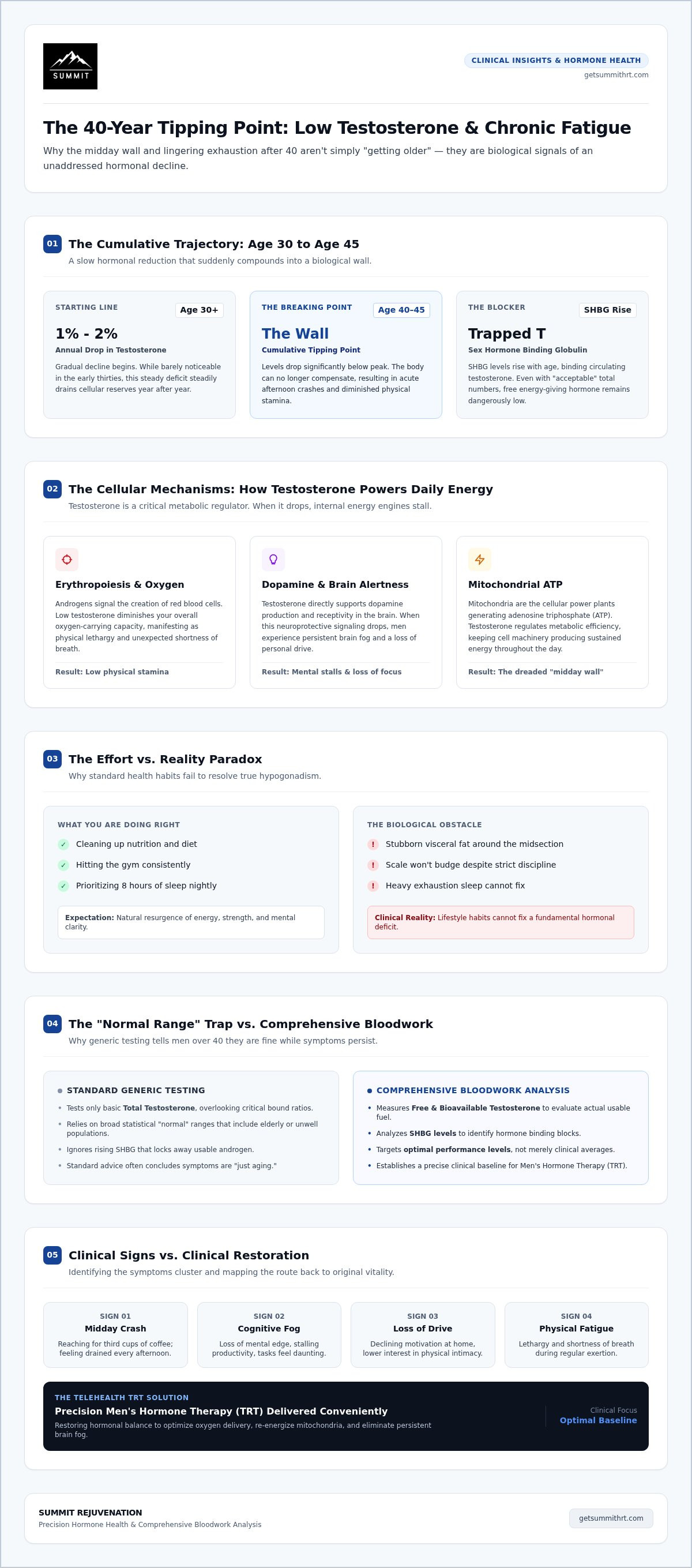
Most men begin to experience a gradual decline in testosterone levels of about 1% to 2% every year once they cross age 30. While this might seem negligible in your early thirties, the cumulative effect often reaches a breaking point between ages 40 and 45. By this time, your levels may have dropped significantly from your peak. Understanding testosterone's role in the body is crucial here; it isn't just about libido. It's a primary driver of your metabolic rate and cognitive clarity. Another factor is Sex Hormone Binding Globulin (SHBG). This protein binds to the testosterone in your blood, making it unavailable for your cells to use. As you age, SHBG levels often rise. This means even if your total testosterone looks acceptable on a standard test, your free energy-giving testosterone might be dangerously low.
When Lifestyle Changes Aren't Enough
It's incredibly frustrating for the man who does everything right but still feels like he's running on empty. You might be cleaning up your diet, hitting the gym, and prioritizing eight hours of sleep, yet the scale won't budge and the exhaustion remains. This happens because lifestyle habits cannot fix a fundamental hormonal deficit. When low testosterone and fatigue in men over 40 take hold, it often presents as a cluster of symptoms including stubborn visceral fat around the midsection and a declining interest in intimacy. If you feel like you've tried every natural remedy without success, it's time to look at the biological root cause rather than just the surface-level symptoms.
The Biology of Exhaustion: How Testosterone Fuels Your Energy
To understand why low testosterone and fatigue in men over 40 are so closely linked, we have to look inside the cells. Testosterone isn't just a hormone for muscle growth; it's a critical metabolic regulator that tells your body how to produce and use energy. When levels drop, the biological machinery that keeps you moving begins to stall. This isn't a simple lack of willpower. It's a fundamental breakdown in how your body generates the fuel required for daily life.
One of the most vital functions of testosterone is its role in erythropoiesis, or the production of red blood cells. These cells are the primary transport system for oxygen. When your androgen levels are low, your body produces fewer red blood cells, which reduces your overall oxygen carrying capacity. This often manifests as physical lethargy and a strange sense of shortness of breath during activities that used to feel effortless. Research into fatigue in aging men confirms that these physiological changes are often the hidden drivers behind the "midday wall" that many men experience.
Beyond the physical, testosterone acts as a neuroprotective agent in the brain. It directly influences the production and receptivity of dopamine, the neurotransmitter responsible for motivation, focus, and cognitive alertness. When your brain lacks this hormonal support, you don't just feel tired; you feel uninspired and mentally "foggy." If you're tired of waking up exhausted, starting with a Comprehensive Bloodwork Analysis can provide the clarity you need to identify these biological gaps.
Mitochondria and Cellular Vitality
Mitochondria are the literal power plants of your cells, responsible for creating adenosine triphosphate (ATP), which is the primary energy currency of the body. Testosterone signals these power plants to operate at peak efficiency. When androgen levels are insufficient, ATP production in muscle tissue drops significantly. This is why many men feel physically weak or "heavy" even if they haven't lost significant muscle mass yet. The cells simply aren't producing the energy needed to power your movements.
The Sleep-Testosterone Feedback Loop
Sleep and testosterone exist in a delicate, reciprocal feedback loop. The majority of your daily testosterone production occurs during deep, restorative sleep. If your sleep is fragmented or too short, your T levels will plummet the following day. Conversely, low testosterone is a known cause of sleep fragmentation and insomnia. This creates a vicious cycle where you wake up tired because your hormones are low, and your hormones stay low because you can't get quality sleep. Regulating your circadian rhythm often requires addressing this hormonal root cause to restore a healthy sleep-wake cycle.
The 'Normal' Range Trap: Why Your Labs Might Be Lying to You
Many men over 40 visit their doctor complaining of persistent exhaustion, only to be told their bloodwork is "normal." This is perhaps the most frustrating roadblock in treating low testosterone and fatigue in men over 40. The standard reference range used by most labs is a broad statistical average that includes men of all ages and health statuses. If your result falls anywhere between 300 and 1,000 ng/dL, you're often dismissed as healthy. However, a 40-year-old man shouldn't be held to the same biological standard as an 80-year-old.
Falling within a range doesn't mean you're functioning at your best. You can read more about Why Your 'Normal' Bloodwork Results Might Still Mean Your Hormones Are Out of Balance to understand why these generic numbers fail to tell the whole story. To truly reclaim your vitality, we have to look past the "average" and focus on what's optimal for your specific life stage.
The Flaw in Standard Lab Testing
The way labs calculate these ranges is fundamentally flawed for anyone seeking peak performance. These numbers are based on the average of people who visited that lab recently, many of whom were already seeking medical care for underlying illnesses. Over the last several decades, these population averages have steadily declined. Being "average" in a population that is increasingly sedentary and metabolically unhealthy doesn't mean you're thriving. Most primary care physicians look for disease states rather than hormonal optimization. They are trained to identify when you are clinically sick, not when your symptoms of low testosterone are preventing you from living a full, energetic life.
What 'Optimal' Looks Like for Men Over 40
Optimization moves beyond the goal of "not sick" and focuses on restoration. We look for the "Optimal Range," which is the specific level where your energy, mood, and libido return to their peak states. A critical part of this process is distinguishing between Total Testosterone and Free Testosterone. Total T is the total amount in your blood, but much of it is bound to proteins and unusable by your cells.
Free testosterone is the bioavailable portion that actually fuels your metabolism and brain function. If your Free T is low, you'll still experience chronic exhaustion regardless of what your Total T number says. While clinical data provides a guide, the ultimate goal is symptom resolution. At the end of the day, the numbers on a page matter far less than how you actually feel when you wake up in the morning.
Comprehensive Bloodwork Analysis: The Roadmap to Recovery
Identifying the biological cause of your exhaustion requires more than a single data point. While a basic screening might check your total levels, a Comprehensive Bloodwork Analysis serves as the essential diagnostic roadmap for addressing low testosterone and fatigue in men over 40. A single "Low T" test is often insufficient because it fails to account for the complex interplay of hormones that govern your energy. To build a safe and effective treatment plan, we must look at the entire endocrine system, ensuring that every marker is moving toward an optimal state rather than just a baseline of "not sick."
This thorough approach also helps identify fatigue mimics. Sometimes, chronic tiredness stems from thyroid dysfunction or nutrient deficiencies that standard tests overlook. By examining markers like Estradiol for estrogen balance, PSA for prostate health, and a Complete Blood Count (CBC) to monitor blood viscosity and oxygen capacity, we ensure your path to restoration is medically sound. Our telehealth model simplifies this process. You can skip the crowded waiting rooms and have your labs handled with professional efficiency, allowing you to focus on your recovery rather than logistical hurdles.
Essential Lab Markers for Men Over 40
Your bloodwork should provide a clear picture of your current physiological state. Total and Free Testosterone are the primary energy indicators, but they don't work in isolation. We also monitor Luteinizing Hormone (LH), which helps determine whether your low levels are a result of a primary issue in the testicles or a secondary issue in the brain's signaling. Additionally, markers like DHEA-S and Vitamin D are included as supporting players. These often act as precursors or co-factors in energy production, and optimizing them can significantly accelerate your return to vitality.
Interpreting Your Results with a Specialist
Reading hormone labs is a specialized skill that goes beyond checking for out-of-range flags. A general practitioner is trained to spot disease, but a hormone specialist is trained to spot opportunities for optimization. We analyze your results to create a personalized baseline, allowing for long-term health monitoring that evolves with you. This collaborative process ensures that your treatment is tailored to your specific symptoms and goals. For a deeper look at how these results inform your care, explore The Modern Guide to Men's Hormone Therapy (TRT). If you're ready to stop guessing and start measuring, you can schedule your Comprehensive Bloodwork Analysis today to begin your journey back to peak performance.
Restoring Vitality: Men's Hormone Therapy (TRT) and Telehealth
Men's Hormone Therapy (TRT) isn't just about supplementation; it's about restoration. By directly addressing the biological deficits we've discussed, TRT provides the fuel your body has been missing. For those struggling with low testosterone and fatigue in men over 40, this therapy acts as a catalyst for systemic change. It restarts the cellular processes that generate energy, clear brain fog, and restore your original drive. This isn't a temporary fix; it's a long-term strategy to bring your body back into its optimal state.
Traditional medical models often require frequent, time-consuming office visits that can feel like a second job. Our telehealth model removes these barriers. You get direct access to experts who specialize in hormone optimization without the need to travel or sit in clinical lobbies. This approach prioritizes your privacy and fits seamlessly into a busy professional schedule. Once your Comprehensive Bloodwork Analysis is reviewed and your plan is finalized, medications are shipped directly to your door. Summit Rejuvenation has streamlined the logistics so you can focus entirely on your results.
The timeline of energy restoration is a steady progression. Most men notice subtle shifts in mood and mental clarity within the first few weeks of starting Men's Hormone Therapy (TRT). By the second month, physical stamina typically begins to climb, and the "midday wall" starts to crumble. By the 90-day mark, your body has usually reached a new, stable baseline where consistent energy becomes your standard once again.
The Summit Rejuvenation Approach
We don't believe in generic protocols. Your treatment plan is built specifically around your unique bloodwork and symptom profile. We provide ongoing monitoring to ensure your levels stay in the optimal range while maintaining the highest safety standards. This isn't a transactional service; it's a partnership. We prioritize your education and proactive health management, giving you the tools to understand your biology and maintain peak performance for years to come.
Starting Your Journey to Peak Energy
Reclaiming your vitality is a straightforward, three-step process designed for efficiency. It begins with a specialized medical consultation, followed by a Comprehensive Bloodwork Analysis to identify your specific needs, and concludes with a personalized treatment plan delivered to your home. 2026 is the year to stop settling for "average" energy and start living with the focus you deserve. You can schedule your consultation with Summit Rejuvenation today to take the first step toward peak performance.
Reclaim Your Edge and Restore Your Vitality
You don't have to accept chronic exhaustion as a permanent part of your life. We've explored how low testosterone and fatigue in men over 40 are deeply connected, and how standard lab results often fail to show the full picture. By shifting your focus from being "not sick" to reaching an optimal hormonal state, you can finally clear the brain fog and restore your daily drive. It's about moving past the "aging myth" and addressing the biological root of your exhaustion with precision and clarity.
Achieving this transformation doesn't require jumping through hospital hoops. Summit Rejuvenation simplifies the path to recovery with a Comprehensive Bloodwork Analysis for every patient and convenient telehealth consultations from the comfort of home. Once your personalized plan is set, medications are shipped directly to your door. You deserve a healthcare partner that prioritizes precision and your long-term performance over generic population averages.
It's time to stop surviving the day and start leading it with the strength and clarity you deserve. Your journey back to peak energy starts with a single, proactive step toward optimization.
Frequently Asked Questions
Can low testosterone cause extreme fatigue even if I'm active?
Yes, low testosterone can cause extreme fatigue even if you maintain an active lifestyle. Exercise requires cellular energy, which is driven by testosterone's role in mitochondrial function. When your levels are low, your body struggles to produce ATP, the primary fuel for your muscles. You might find that you can push through a workout but feel completely drained for the rest of the day. It's a biological deficit that fitness alone cannot overcome.
How quickly will I feel more energetic after starting TRT?
Most men begin to notice improvements in mental clarity and mood within the first three to four weeks of treatment. Significant changes in physical energy and stamina typically follow during the second month. By the time you reach the 90-day mark, your body has usually adjusted to its new, optimized baseline. This steady progression allows your system to safely recalibrate, ensuring that your energy restoration is both consistent and sustainable over the long term.
Is fatigue at 40 always caused by low testosterone?
Fatigue at 40 isn't always caused by a hormonal imbalance, though it's one of the most common drivers. Other conditions like thyroid dysfunction, vitamin deficiencies, or poor sleep quality can present similar symptoms. Summit Rejuvenation utilizes a Comprehensive Bloodwork Analysis to distinguish between these factors. This thorough diagnostic process ensures we address the actual root cause of your exhaustion rather than simply treating a single symptom without understanding the full biological context.
What is the difference between 'normal' and 'optimal' testosterone levels?
The 'normal' range is a statistical average that includes men of all ages, including those who are elderly or unhealthy. In contrast, an 'optimal' level is the specific range where you feel your best and your symptoms resolve. For those dealing with low testosterone and fatigue in men over 40, being at the bottom of a 'normal' range often isn't enough. We aim for levels that restore your original vitality and peak performance.
Does TRT help with the 'brain fog' that comes with fatigue?
TRT is highly effective at addressing the brain fog that often accompanies hormonal exhaustion. Testosterone serves as a neuroprotective agent and directly impacts dopamine production, which is essential for focus and motivation. When your levels are optimized, the mental haze typically lifts, allowing for better cognitive alertness and productivity. Many patients report that this return of mental sharpness is one of the most significant benefits they experience during their first few months of therapy.
Can I get TRT through a telehealth consultation?
You can absolutely access Men's Hormone Therapy (TRT) through a telehealth model. Summit Rejuvenation provides specialized medical consultations and coordinates your Comprehensive Bloodwork Analysis remotely. This approach offers the privacy and convenience that busy professionals require. Once a personalized treatment plan is established, all necessary medications are shipped directly to your home. This streamlined process ensures you receive expert care without the need for frequent, time-consuming visits to a traditional clinical office.
What happens if my bloodwork shows my testosterone is 'normal' but I'm still tired?
If your results are 'normal' but you still feel exhausted, we look at your 'Free Testosterone' and Sex Hormone Binding Globulin (SHBG). Total testosterone doesn't always reflect how much hormone is actually available for your cells to use. Many men suffer from low testosterone and fatigue in men over 40 because their bioavailable T is too low, even if their total number looks fine. We prioritize how you feel and your symptom resolution over generic lab averages.
Are there side effects of TRT that could actually make me more tired?
While rare, improper dosing can lead to an excessive increase in red blood cell production, which might cause a feeling of sluggishness. This is why professional monitoring is so vital. At Summit Rejuvenation, we use ongoing bloodwork to fine-tune your protocol and ensure your levels stay within a safe, optimized range. Our goal is to maximize your energy while proactively managing your health markers to prevent any side effects that could interfere with your restoration.


Comments