Life After Stopping Semaglutide: A Guide to Maintaining Your Results in 2026
Research published in early 2026 reveals that individuals who stop GLP-1 therapy without a medical exit strategy regain an average of 1.76 pounds every month, typically returning to their baseline weight within 18 months. If you're feeling a mix of pride in your progress and a deep fear that "food noise" is waiting just around the corner, you aren't alone. It's frustrating to feel like your long term success is tied to a weekly injection, but the biological reality of life after stopping semaglutide doesn't have to mean a return to your starting point.
You can break the cycle of regain and secure your metabolic health for the long term. We'll show you exactly how a structured medical transition, focused on hormone optimization and metabolic bridging, can stabilize your weight and protect your lean muscle. You'll discover that maintaining your results is about more than willpower; it's about managing the physiological ghrelin surge that occurs when the medication clears your system.
This guide provides a clear roadmap for 2026, covering everything from structured tapering protocols to the essential role of testosterone and thyroid health. You'll learn how to use specific peptides and comprehensive bloodwork to silence hunger signals and ensure your metabolism remains high long after your final dose.
Table of Contents
The Biological Reality of Life After Stopping Semaglutide
The fear of regain isn't just a mental hurdle; it's a documented physiological response. Recent clinical observations from 2026 confirm that without a transition plan, the body aggressively attempts to return to its previous weight. This happens because your biology doesn't see your weight loss as a victory. Instead, it views it as a period of starvation it needs to correct. Understanding the semaglutide mechanism of action is the first step in mastering this transition. While the medication was active, it constantly stimulated GLP-1 receptors to signal fullness. Once you stop, those signals vanish, leaving your brain to manage hunger without the chemical assistance it has relied on for months. This shift marks the beginning of metabolic adaptation, where your body tries to pull you back to your old "set point."
The Return of 'Food Noise' and Appetite
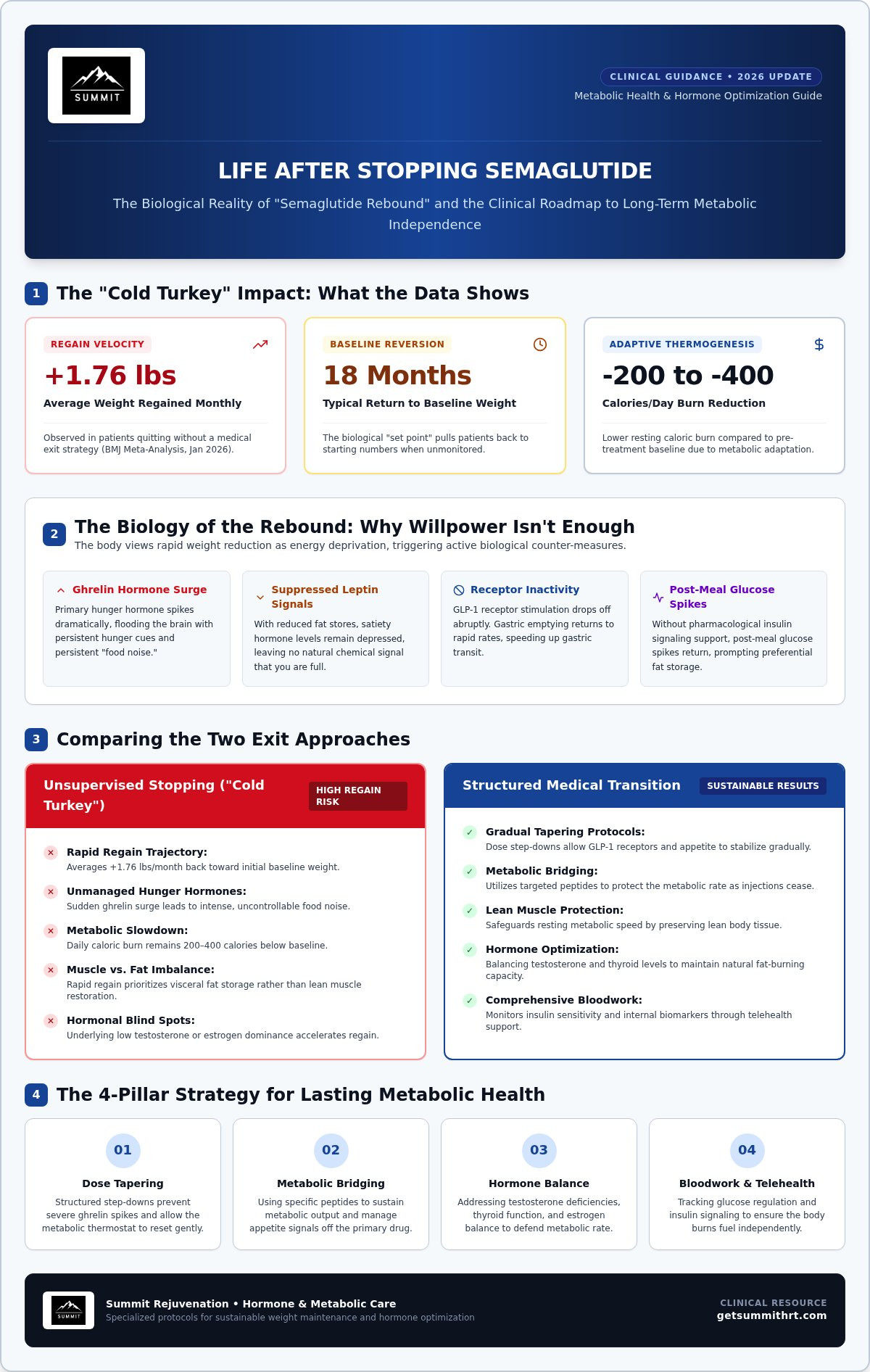
For many, the most jarring part of life after stopping semaglutide is the sudden return of "food noise." These are the intrusive, persistent thoughts about eating that the medication effectively silenced. Biologically, this is triggered by a surge in ghrelin, your primary hunger hormone. As the medication clears your system, ghrelin levels often spike while leptin, the hormone responsible for satiety, remains low due to reduced fat stores. This mismatch creates a psychological vacuum where willpower feels insufficient. It's a biological rebound where your brain demands high calorie fuel to replenish what it perceives as lost energy reserves. Without a strategy to manage this surge, the return of appetite can feel uncontrollable.
Why a 'Cold Turkey' Approach Often Fails
Stopping abruptly often leads to a rapid metabolic relapse. Data from a January 2026 BMJ meta analysis shows that patients who quit "cold turkey" regained an average of 1.76 pounds per month, often returning to their baseline weight within 18 months. Rapid weight regain does more than just affect the scale; it creates a "yo-yo" effect that can damage insulin sensitivity and metabolic flexibility. Your daily caloric burn might be 200 to 400 calories lower than your original baseline due to adaptive thermogenesis. When the body regains weight quickly, it often prioritizes fat storage over muscle restoration. A medically supervised exit strategy is essential to prevent this. Rather than a sudden stop, a proactive transition allows your metabolism to stabilize, ensuring your hard won results become permanent.
Understanding the Metabolic Shift: Why Weight Regain Happens
To successfully navigate life after stopping semaglutide, you must first understand the biological phenomenon known as Semaglutide Rebound. Semaglutide Rebound is a physiological state where the cessation of GLP-1 therapy triggers a sharp increase in appetite and a simultaneous drop in resting metabolic rate, often leading to rapid weight regain as the body attempts to return to its previous "set point." During your treatment, the medication acted as a manual override for your metabolic thermostat, suppressing hunger and slowing gastric emptying. When this override is removed, your brain often perceives the lower weight as a state of energy deficiency. Following Harvard Health guidance on transitioning off GLP-1s is essential to mitigate these signals and protect your progress.
Underlying hormonal imbalances often act as an invisible anchor during this transition. If you're struggling with low testosterone or estrogen dominance, your body lacks the chemical signals required to burn fat efficiently and maintain muscle mass. These deficiencies can accelerate weight regain by further slowing your metabolism. Identifying these gaps through comprehensive bloodwork is the only way to ensure your internal chemistry supports your new weight rather than fighting against it.
The Role of Insulin Sensitivity and Glucose Regulation
Semaglutide significantly improved your insulin signaling, allowing your cells to process glucose more effectively. Once the medication is gone, your body must regain its ability to manage blood sugar independently. Without the pharmacological support, you may experience sharper blood sugar spikes after meals, which signals your body to store excess energy as fat. This is where metabolic flexibility becomes vital. Metabolic flexibility is the body's ability to switch efficiently between burning carbohydrates and burning fat based on availability and demand. Strengthening this flexibility through a personalized vitality plan helps stabilize your energy levels and prevents the post-medication fat storage surge.
The Muscle Mass Factor
One of the most significant risks during rapid weight loss is the loss of lean tissue. Clinical data suggests that between 25% and 40% of weight lost on GLP-1 medications can come from skeletal muscle if resistance training and protein intake aren't strictly prioritized. Because muscle is metabolically active tissue, losing it directly lowers your basal metabolic rate (BMR), meaning you burn fewer calories at rest than you did before. To protect your metabolism, you must focus on muscle preservation through high protein thresholds and consistent strength work. In some cases, utilizing specific peptides for weight loss can provide a "metabolic bridge," helping to preserve lean tissue and support fat oxidation while your body adjusts to life without semaglutide.
Strategies for Sustainable Maintenance in 2026
In 2026, the standard of care for obesity management has evolved. We no longer view weight loss as a temporary project with a fixed end date. Instead, the medical community prioritizes long term metabolic health. When you consider your options for life after stopping semaglutide, you'll likely choose between a "lifestyle only" approach and a "lifestyle plus medical support" model. While diet and exercise are non negotiable foundations, relying on them alone often ignores the biological hunger surge described in earlier sections. Choosing continued medical support isn't about leaning on a "crutch." It's about providing your body with the necessary tools to manage a complex physiological transition.
A proactive medical transition focuses on maintaining your new "set point" while your natural satiety signals recover. This often involves moving away from the heavy lifting of GLP-1 agonists and toward precision therapies that optimize your existing metabolism. By treating the transition as a secondary phase of treatment rather than a total cessation of care, you significantly reduce the risk of the rapid regain that plagues many "cold turkey" attempts.
The Tapering Protocol
The most successful transitions in 2026 utilize a structured tapering protocol. Rather than stopping your injections abruptly, a clinical taper involves gradually reducing your dosage over several months. This slow reduction allows the satiety centers in your brain, specifically the hypothalamus, to recalibrate to lower levels of exogenous GLP-1. During this phase, you should work closely with your provider to monitor hunger levels and "food noise" daily. If hunger becomes intrusive at a specific dose, the taper can be paused or adjusted. This methodical step down prevents the sudden hormonal shock that typically triggers binge eating or metabolic slowdown.
Leveraging Non-GLP-1 Peptides
Another highly effective strategy is the "Switch Method," where patients transition from semaglutide to alternative peptides. These metabolic optimizers, such as growth hormone secretagogues or agents that promote fat oxidation, help bridge the gap without the specific side effects or receptor downregulation associated with GLP-1s. These therapies focus on preserving lean muscle mass and keeping your basal metabolic rate high. By using targeted peptides to support your body composition, you can maintain the aesthetic and health benefits of your weight loss while your insulin sensitivity stabilizes. This approach ensures that your body remains a fat burning machine even as you move away from primary weight loss medications.
The Crucial Link: Hormone Optimization and Bloodwork
Many people attribute weight regain to a lack of willpower, but in reality, it's often a symptom of untreated hormonal decline. If your baseline hormones are deficient, your body lacks the chemical instructions it needs to stay lean and energetic. Life after stopping semaglutide requires a stable internal environment to succeed. Without optimizing your endocrine system, you're essentially trying to build a house on a shifting foundation. When your hormones are balanced, your body is biologically primed to maintain its new weight rather than fighting to return to its old set point.
Why Bloodwork is Your Roadmap
You can't manage what you don't measure. Comprehensive bloodwork provides the data necessary to identify "silent" maintenance killers before they derail your progress. We focus on specific markers like Fasting Insulin and HbA1c to assess your metabolic health, alongside Free Testosterone and full Thyroid panels (including Free T3 and Reverse T3). It's vital to understand that "normal" lab ranges aren't the same as "optimal" vitality ranges. While a standard lab might say your levels are acceptable for your age, we look for the specific levels that allow you to feel and function at your peak. Viewing bloodwork as a preventative tool gives you the foresight to adjust your plan before the scale starts to climb. Schedule your comprehensive bloodwork analysis to establish your metabolic baseline today.
Hormones as the Foundation of Metabolism
Hormones dictate how your body partitions energy. For men, TRT therapy is often the deciding factor in whether they maintain muscle or regain fat. Testosterone directly influences insulin sensitivity and fat metabolism, making it significantly easier to stay lean even when "food noise" returns. Similarly, hormone replacement therapy for women is essential for managing fat distribution and preventing the metabolic slowdown associated with estrogen dominance or progesterone deficiency. We also monitor cortisol levels, as chronic stress can trigger the post-semaglutide "belly fat" regain that many patients fear. Hormone optimization is the restoration of biological levels to their peak efficiency. By balancing these systems, you ensure your metabolism remains resilient and responsive long after your last injection.
Navigating Your Transition with Summit Rejuvenation
Summit Rejuvenation simplifies the complexities of life after stopping semaglutide by providing a structured, science-backed framework for your transition. We don't just provide a prescription; we partner with you to rebuild your vitality from the ground up. Our process begins with a deep dive into your biology through comprehensive bloodwork, which serves as the blueprint for your journey. Once your labs are analyzed, you'll meet with a provider via telehealth to discuss a personalized plan tailored specifically to your metabolic needs and hormonal profile. This methodical approach ensures that every decision is based on data rather than guesswork.
Maintaining your results shouldn't feel like a full time job. Our model is built for the modern individual, offering the convenience of having all maintenance medications and peptides shipped directly to your door. This streamlined delivery removes the logistical hurdles that often lead to gaps in care. By positioning ourselves as a long term partner in your health, we provide the ongoing support necessary to navigate the physiological shifts that occur after GLP-1 therapy ends. You deserve a transition that feels professionally managed and deeply supportive.
The Telehealth Advantage for Maintenance
The traditional medical model often fails during the maintenance phase because it lacks consistent follow up. Our telehealth platform bridges this gap by facilitating regular virtual check-ins that allow us to catch potential weight regain before it gains momentum. Accessing online HRT through our system makes it easy to stay on top of your metabolic health without the need for frequent office visits. This digital first approach allows for real-time feedback and rapid adjustments to your protocol. If your hunger signals change or your energy levels dip, we can refine your plan immediately to keep your progress on track.
Your Next Steps for Long-Term Vitality
Securing your future health begins with a single, proactive step. Your journey toward permanent metabolic independence starts by scheduling a comprehensive bloodwork panel to identify any hormonal or nutritional deficiencies. During your initial consultation, a Summit provider will review your results in detail, explaining how your current levels impact your ability to keep weight off. You'll walk away with a clear roadmap that prioritizes your long term vitality over short term fixes. We believe in a life where weight maintenance is managed by precision science and professional guidance; it's time to move beyond the limitations of willpower alone.
Mastering Your Long-Term Vitality
Transitioning into life after stopping semaglutide requires more than just willpower; it demands a strategic medical framework. You've learned that weight regain is often driven by a surge in hunger hormones and a drop in metabolic rate, but these biological shifts are entirely manageable with the right expertise. By prioritizing a structured clinical taper and utilizing metabolic bridging agents like targeted peptides, you can protect your lean muscle and stabilize your natural satiety signals for the long term.
Hormone optimization remains the ultimate safeguard for your metabolic health. When your testosterone and thyroid levels are balanced, your body works with you rather than against you. Summit Rejuvenation offers expert medical providers who specialize in metabolic health and provide convenient telehealth consultations nationwide. We design personalized vitality plans based on your unique biology to ensure your results last a lifetime. You've done the hard work of losing the weight; now it's time to secure your future.
Take Control of Your Metabolism: Schedule Your Comprehensive Bloodwork Today
Your journey doesn't end when the injections stop. With a science-backed transition plan, you can enjoy a life of reclaimed vitality and permanent freedom from food noise.
Frequently Asked Questions
How much weight do people typically gain back after stopping Semaglutide?
Clinical data from 2026 suggests that patients who stop GLP-1 medications without a maintenance plan regain an average of 1.76 pounds per month. Many return to their baseline weight within 18 months. This rebound is often caused by a surge in hunger hormones and a suppressed metabolic rate. However, life after stopping semaglutide can be successful if you use a structured medical transition to stabilize your energy expenditure and manage appetite signals during the critical post-treatment window.
Can I use peptides to help maintain my weight loss after stopping GLP-1s?
You can certainly use specific peptides to bridge the gap during your transition. While semaglutide targets GLP-1 receptors, other peptides focus on growth hormone secretion or fat oxidation. These tools help maintain your body composition by protecting lean muscle and keeping your basal metabolic rate elevated. This approach allows your body to adjust to lower medication levels without the sharp metabolic drop that typically triggers rapid weight regain after your final dose.
How long does it take for hunger to return after the last injection?
Hunger typically begins to return within one to two weeks as the medication's concentration in your blood drops. Because semaglutide has a half life of about seven days, it takes roughly four to five weeks to clear your system entirely. During this window, the intrusive thoughts about food that were suppressed often return as a physiological surge. Managing this transition with medical support helps your brain's satiety centers recalibrate without the overwhelming hunger signals that lead to overeating.
Do I need to stay on hormone therapy forever to keep the weight off?
You don't necessarily need to stay on hormone therapy forever to maintain your results. The duration of therapy depends on your unique biology and whether your body can maintain optimal levels independently. For many, hormone optimization provides the foundation needed to keep the weight off by supporting a healthy metabolism. Once your metabolic health is stabilized and your lifestyle habits are firmly in place, you and your provider can determine the best long term maintenance strategy.
Is it possible to taper off Semaglutide without gaining any weight?
It is possible to taper off semaglutide without gaining weight if you follow a structured medical protocol. Success often depends on a gradual reduction of your dose over several weeks rather than stopping abruptly. This slow step down gives your metabolism and appetite hormones time to adapt. When combined with hormone optimization and muscle sparing peptides, a taper allows you to maintain your new set point while your body's natural satiety signals recover.
What are the most important blood markers to check after stopping weight loss medication?
The most critical markers to monitor include fasting insulin, HbA1c, and a full thyroid panel including Free T3 and Reverse T3. These labs reveal how well your body is managing glucose and whether your metabolism is slowing down. Additionally, checking Free Testosterone is vital for both men and women to ensure you aren't losing the muscle mass required to burn calories. These markers provide the data needed to adjust your vitality plan before regain starts.
Will my metabolism ever return to 'normal' after being on these drugs?
Your metabolism will stabilize, but it may not return to its original baseline without proactive support. Significant weight loss often triggers adaptive thermogenesis, where the body burns fewer calories to conserve energy. Successfully navigating life after stopping semaglutide requires you to support your metabolic rate through resistance training and hormonal balance. These interventions prevent your resting metabolic rate from remaining suppressed, ensuring your body stays efficient at burning fuel even as your medication levels decrease.
Can TRT help me keep the muscle I gained while on Semaglutide?
TRT is a powerful tool for preserving the muscle mass you worked hard to keep during your weight loss journey. Testosterone is naturally muscle sparing and helps improve insulin sensitivity, making it easier for your body to prioritize burning fat for fuel. By maintaining optimal testosterone levels, you prevent the muscle catabolism that often occurs when caloric intake increases after stopping GLP-1s. This protection is essential for keeping your basal metabolic rate high and preventing fat rebound.


Comments