Signs of Low Testosterone in Men: The 2026 Guide to Optimal Vitality
Updated: Aug 27
What if your doctor told you your health was "normal," but you still felt like a shadow of your former self? It's incredibly frustrating to put in the work at the gym and prioritize sleep, only to be met with chronic fatigue and a softening physique. You aren't alone in noticing these subtle signs of low testosterone in men, yet many professionals are dismissed because their bloodwork falls within a massive, outdated reference range. We believe that "average" shouldn't be your health standard, especially when brain fog and decreased performance begin to impact your career and personal life.
You deserve to reclaim the sharp mental focus and physical drive that once defined your daily routine. This 2026 guide empowers you to identify the symptoms that truly matter and explains why traditional lab interpretations often fail high-performing men. We'll explore the path toward restored energy and libido through a modern medical partnership designed to move you beyond "normal" and into a state of true clinical optimization. By the end of this article, you'll have a clear, professional roadmap to navigate your hormonal health with the latest clinical insights and precision care.
Table of Contents
Recognizing Low Testosterone: More Than Just "Getting Older"
For decades, men have been conditioned to believe that a steady decline in energy, motivation, and physical strength is simply an unavoidable tax paid for getting older. This narrative is not only discouraging, it's also medically incomplete. While your levels naturally dip by about 1% to 2% annually after age 30, a drastic loss of vitality often points to a clinical condition known as Hypogonadism. In 2026, we understand that "normal" aging shouldn't feel like a slow-motion collapse of your quality of life or your ambition.
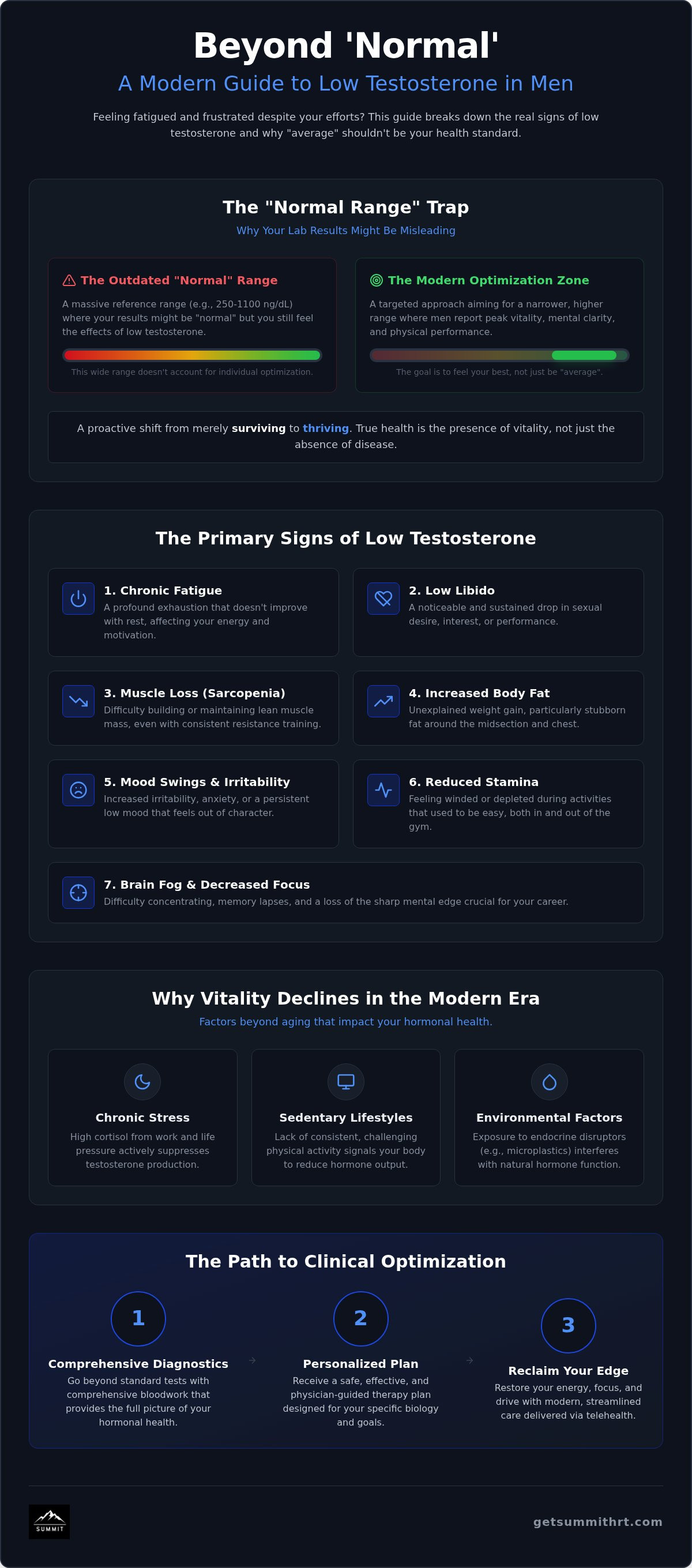
Recognizing the early signs of low testosterone in men is the first step toward reclaiming your edge. Instead of accepting a diminished state, modern hormone optimization focuses on restoring your levels to a range where you feel and perform at your peak. It's a proactive shift from merely surviving to thriving. We don't just look for a lack of disease; we look for the presence of health.
The Biological Importance of Testosterone
Testosterone acts as a master regulator for the male body. It does much more than drive your libido; it's the primary fuel for your metabolic engine. Optimal levels of this hormone help regulate fat distribution and maintain lean muscle mass by improving protein synthesis. When these levels drop, you might notice your body composition changing despite your best efforts in the gym.
Beyond the mirror, testosterone is essential for bone density and the production of red blood cells. These cells are responsible for oxygen transport throughout your system. If your "oxygen delivery" is compromised due to low androgen levels, chronic fatigue becomes your new baseline. Your brain and muscles simply aren't getting the resources they need to function at a high level.
Why Vitality Declines in the Modern Era
Modern life presents unique challenges to hormonal health that previous generations rarely faced. We're constantly exposed to environmental endocrine disruptors and microplastics that interfere with natural hormone production. These factors, combined with our fast-paced culture, create a perfect storm for hormonal imbalance.
Chronic Stress: Persistent workplace pressure keeps cortisol levels high, which directly inhibits your body's ability to produce testosterone.
Sedentary Habits: A lack of consistent movement and resistance training signals your body to lower its androgen output.
Endocrine Disruptors: Common chemicals in our environment can mimic estrogen or block testosterone receptors entirely.
Identifying the signs of low testosterone in men requires a high level of self-awareness. These symptoms rarely arrive with a bang; instead, they whisper, slowly accumulating until your quality of life feels fundamentally altered. Understanding these indicators allows you to consider treatment before your professional and personal relationships suffer. If you've noticed a persistent decline in your drive, it's likely not just "stress" or "a busy week."
The most common indicators of a hormonal deficit include:
Chronic Fatigue: A bone-deep exhaustion that persists even after eight hours of sleep.
Low Libido: A noticeable and sustained drop in sexual desire or interest.
Muscle Loss: Difficulty maintaining lean mass despite consistent resistance training.
Body Fat Increase: Unexplained weight gain, particularly around the midsection.
Mood Volatility: Increased irritability or a general feeling of being "on edge."
Reduced Stamina: Feeling winded or depleted during activities that used to be easy.
Erectile Dysfunction: Difficulty achieving or maintaining firm erections.
Physical Red Flags You Should Not Ignore
The psychological impact of low testosterone is often misdiagnosed as clinical depression. This "depressive mask" can lead to a profound loss of professional ambition and a withdrawal from social circles. You might find yourself avoiding challenges you once relished or feeling a sense of apathy toward your goals. Brain fog is a specific neurological symptom of androgen deficiency that manifests as mental cloudiness, slowed information processing, and a persistent inability to focus on complex tasks. This cognitive friction makes every workday feel like an uphill battle. If you're struggling to maintain your mental edge, a professional hormonal evaluation can help distinguish between burnout and a treatable medical condition.
The "Normal Range" Trap: Why Your Lab Results Might Be Lying
You walk into a clinic feeling every one of the signs of low testosterone in men, yet your lab results come back with a "normal" stamp. This is the most common hurdle high-performing men face. Traditional reference ranges are calculated using a broad average of the general population. This includes men of all ages, health conditions, and activity levels. It's a statistical bell curve, not a blueprint for peak performance.
If you're 35 and your levels match the average of an 80-year-old, you'll still fall within that "normal" window. This is why so many men are dismissed by their primary care providers. You aren't seeking to be "statistically average" among a group of potentially unhealthy individuals; you're seeking to reclaim your personal best. Being told you're "fine" while you're struggling with brain fog and exhaustion is a failure of modern standard care.
Total vs. Free Testosterone: The Real Story
Most standard tests only measure Total Testosterone. This number tells a very incomplete story. Your body produces Sex Hormone Binding Globulin (SHBG), a protein that acts like a lock, binding to your hormones and making them unusable by your tissues. If your SHBG is high, your Total T might look great on paper, but your body can't actually use it.
Free Testosterone is the "unlocked" portion that's actually bioavailable. It's the only metric that truly reflects your daily vitality and cognitive clarity. A comprehensive bloodwork analysis is the only way to see past the Total T facade and understand how much hormone is actually working for you. Without this level of detail, you're only seeing half the picture.
Optimal vs. Standard Lab Ranges
At Summit, we prioritize an "optimal" range over a "standard" one. Clinical optimization means finding the specific level where your symptoms resolve and your performance returns. We treat the patient, not just the number on a page. If you're experiencing the signs of low testosterone in men but your labs say you're fine, we look deeper. Age-adjusted benchmarks are essential here.
A man in his prime shouldn't be forced to live with the hormonal profile of someone twice his age. We use these precise metrics to build a tailored plan that reflects your actual biological needs. This ensures your results translate into real-world energy and focus. We don't just aim for the absence of disease; we aim for the presence of peak vitality.
Evaluating Your Options: Lifestyle Changes vs. Clinical TRT
Most men who recognize the signs of low testosterone in men initially attempt to solve the problem in the kitchen or the gym. We applaud this proactive spirit. Optimizing your sleep hygiene, cleaning up your diet, and engaging in heavy resistance training are the pillars of any health strategy. However, there is a biological ceiling to what lifestyle alone can achieve. If your body has lost the fundamental ability to produce sufficient androgens, no amount of kale or squats will bridge that gap.
This is what we call the Plateau Point. It's the moment where your effort exceeds your results, and your progress stalls despite perfect discipline. At this stage, relying solely on lifestyle is like trying to drive a car with an empty fuel tank; you can polish the exterior all you want, but the engine won't turn over. This is where TRT therapy becomes a necessary clinical tool for restoration, moving you past the limits of self-optimization.
When Lifestyle Changes Are Not Enough
Age-related hormonal decline is a physiological reality that diet cannot fully reverse. While healthy habits support your system, clinical intervention provides the essential jumpstart required to make those habits effective again. If you've identified the signs of low testosterone in men but find your progress has hit a wall, clinical support is the logical next step. Many men lose years to unmonitored over-the-counter boosters that promise miracles but deliver little more than expensive disappointment. These supplements often lack clinical backing and can even introduce unnecessary risks without providing the precision your body requires.
The Modern TRT Experience
It's time to move past the bodybuilder myths of the 1990s. Modern testosterone replacement treatments are not about achieving supra-physiological levels for vanity. They are about medical restoration. When managed by experts, the safety profile of these treatments is excellent, focusing on returning you to a state of optimal balance. Precision dosing, informed by your unique bloodwork, prevents common side effects and ensures a smooth, sustainable transition back to vitality. If you’re ready to stop guessing and start optimizing, schedule your comprehensive bloodwork analysis today to see what your body truly needs.
The Summit Path: Precision Hormone Optimization via Telehealth
Recognizing the signs of low testosterone in men is a powerful first step, but the path to restoration shouldn't be cluttered with the logistical hurdles of traditional medicine. Many men postpone care because the prospect of multiple in-person visits and sterile waiting rooms feels like a drain on their already limited energy. Summit Rejuvenation bridges this gap by offering a sophisticated, nationwide telehealth experience that prioritizes your time and privacy. We've replaced clinical coldness with a streamlined, human-centric approach that allows you to manage your hormonal health from the comfort of your home.
The journey begins with a commitment to precision. Accessing HRT online through our platform is a collaborative process designed to uncover the root cause of your symptoms. We don't believe in generic protocols; instead, we use your unique biological data to build a roadmap toward peak performance. This is modern medical innovation tailored for the high-achiever who demands results without the unnecessary friction of a legacy healthcare model.
Step-by-Step: From Bloodwork to Vitality
Your transformation starts with a comprehensive lab panel. This isn't a basic screening; it's a deep dive into your metabolic and hormonal health. Once your results are ready, you'll engage in a detailed telehealth consultation with an expert who understands the nuances of male optimization. During this session, we'll review your biomarkers and discuss how they correlate with the signs of low testosterone in men you've been experiencing. After your personalized protocol is established, your medications are prescribed and shipped directly to your door for seamless integration into your daily life.
Ongoing Support and Monitoring
True optimization is a marathon, not a sprint. We provide continuous monitoring through regular follow-up labs to ensure your therapy remains safe and effective as your body changes. This ongoing partnership allows us to fine-tune your dosage, ensuring you stay within the optimal range rather than just drifting into "average" territory. As your energy returns and your mental clarity sharpens, your needs will evolve, and our team will be there to guide you through every phase of your reclamation.
Don't let another month slip by in a state of diminished vitality. Schedule your consultation with Summit Rejuvenation today and take decisive action toward your best self.
Take Decisive Action Toward Your Peak Vitality
You've now seen that the signs of low testosterone in men are more than just a byproduct of aging; they're clear signals that your body's internal chemistry needs professional attention. Accepting chronic fatigue or a loss of drive as your new reality is no longer necessary. By moving past the "normal range" trap and prioritizing comprehensive bloodwork, you can unlock a level of vitality that traditional primary care often overlooks. You deserve a health standard that prioritizes how you feel over a statistical average.
The path to restoration is now simpler and more precise than ever. Through our nationwide telehealth platform, you gain access to expert-led consultations and personalized optimization plans without the need for inconvenient in-person visits. Every step is handled with professional care, from the initial lab analysis to having your medications shipped directly to your door. You don't have to navigate this journey alone when a dedicated medical partner is ready to help you thrive.
Reclaim your vitality and schedule your comprehensive bloodwork with Summit Rejuvenation. It's time to stop settling for "fine" and start living at your peak.
Frequently Asked Questions
What are the first signs of low testosterone in men?
Early indicators often include a subtle drop in morning energy, reduced sexual interest, and a feeling that your recovery after exercise is slowing down. You might also notice that your mood is slightly more irritable or that your concentration isn't as sharp as it used to be. These signs of low testosterone in men often appear gradually, making them easy to dismiss as simple stress or overwork.
Can I have low T even if my doctor says my results are normal?
Yes, because standard reference ranges are based on broad population averages rather than individual optimization. A "normal" result for an 80-year-old is statistically categorized the same as a result for a 30-year-old. If you're experiencing symptoms but fall within the lower end of the laboratory's range, you may still be clinically deficient. We focus on how you feel and your unique biomarkers rather than just a number.
At what age should I start checking my testosterone levels?
Most men should establish a baseline level in their late 20s or early 30s. Since testosterone typically declines by about 1% to 2% every year after age 30, having a baseline allows you to track your personal rate of decline. If you begin noticing signs of low testosterone in men earlier, such as unexplained fatigue or loss of muscle mass, you should request a comprehensive lab panel regardless of your age.
Will TRT help me lose weight and gain muscle?
TRT is a powerful tool for improving body composition, but it works best alongside proper diet and resistance training. By restoring your hormone levels, you improve your body's ability to burn fat and synthesize protein for muscle growth. It essentially removes the metabolic brakes caused by deficiency. This clinical support provides the physiological foundation needed for your hard work in the gym to finally produce visible, lasting results.
What is the difference between total and free testosterone?
Total testosterone measures the entire amount of the hormone in your blood, including the portion bound to proteins like SHBG. Free testosterone represents the unbound portion that's actually available for your tissues to use. Many men have adequate total levels but very low free levels, which means their body can't access the hormone. Measuring both is essential for a truly comprehensive understanding of your hormonal health and daily vitality.
Are there any side effects to starting hormone replacement therapy?
Like any medical intervention, TRT can have side effects, but these are significantly minimized through precision dosing and regular monitoring. Potential issues may include changes in skin oiliness, mild fluid retention, or shifts in red blood cell counts. We use frequent follow-up bloodwork to track these markers and adjust your protocol as needed. This proactive approach ensures your therapy remains safe, effective, and tailored specifically to your body's unique responses.
How long does it take to feel the benefits of TRT?
Most men notice improvements in mood and mental clarity within the first three to four weeks of treatment. Physical changes, such as increased strength and fat loss, typically become more apparent between three and six months. While sexual benefits often appear early, the full metabolic and physical transformation is a steady process that rewards consistency. Your body needs time to recalibrate its systems as your hormone levels stabilize in the optimal range.
Is telehealth TRT as effective as visiting a local clinic?
Telehealth is just as effective and often more convenient than traditional in-person visits. Our model utilizes the same gold-standard bloodwork and expert medical consultations you'd find at a high-end physical clinic. The primary difference is the streamlined delivery of care. You receive professional guidance and have your medications shipped directly to your door, eliminating the geographic and scheduling barriers that often prevent men from seeking the help they truly need.


Comments