Symptoms of Low Estrogen in Women: The 2026 Checklist for Precision Vitality
What if the lab results your doctor called "normal" are actually the very thing standing between you and the vitality you deserve? It's incredibly frustrating to feel a shadow of your former self, struggling with persistent brain fog and a dwindling libido, only to be told that your health is fine on paper. You know your body better than a standardized reference range, and the symptoms of low estrogen in women shouldn't be something you're forced to ignore. You deserve clarity and a path forward that acknowledges your unique experience rather than dismissing it.
In this guide, we'll uncover the hidden physical and cognitive signs of estrogen deficiency that often fly under the radar. We'll move beyond basic checklists to look at how these hormonal shifts impact your professional performance and long-term physical health. We're providing a comprehensive 2026 update on why traditional testing often fails to capture the full picture of your health. You'll gain a clear roadmap to reclaiming your edge and learn how personalized, expert-led care can help you finally feel like yourself again.
Table of Contents
Beyond Reproduction: The Vital Role of Estrogen in Female Health
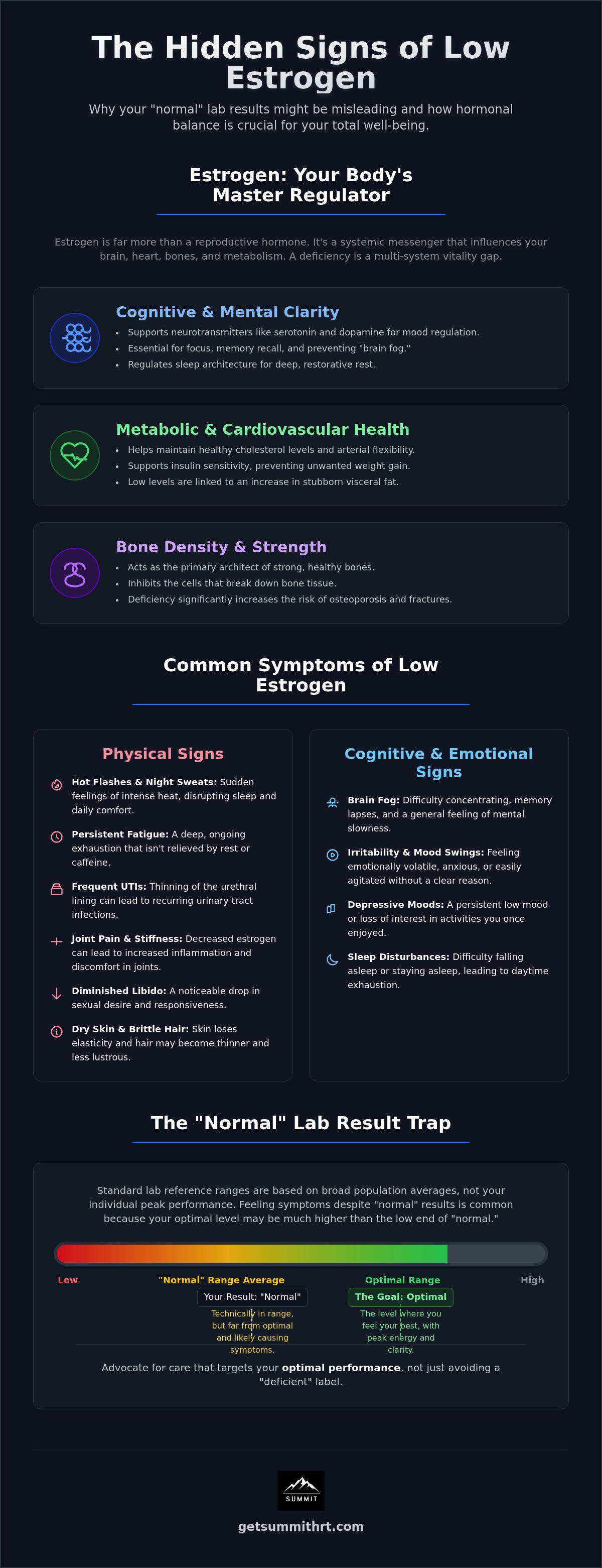
Estrogen isn't just a "fertility hormone." It's a systemic master regulator that touches almost every tissue in your body. From the neurons in your brain to the cells in your heart and the density of your bones, this hormone dictates how you feel and function daily. It acts as a chemical messenger that coordinates complex processes, ensuring your systems work in harmony. Estrogen deficiency is a multi-system vitality gap rather than just a reproductive issue.
Your body utilizes three primary forms of this hormone. Estradiol (E2) is the most potent and active form during your reproductive years, driving your energy and cognitive health. Estrone (E1) becomes the dominant form after menopause, while Estriol (E3) is primarily active during pregnancy. When these levels fall out of balance, a condition known as Hypoestrogenism can occur, leading to a cascade of systemic issues that affect your entire quality of life.
Many women experience these shifts long before they reach menopause. During perimenopause, levels don't just drop; they fluctuate wildly. This instability is often why the early symptoms of low estrogen in women are so hard to pin down. You might feel perfectly fine one week and completely depleted the next as your body struggles to adapt to these internal waves.
The Brain-Estrogen Connection
Your brain is packed with estrogen receptors. This hormone is essential for neurotransmitter function, specifically supporting serotonin and dopamine levels that regulate your mood and drive. When estrogen declines, your cognitive clarity often goes with it. This is the biological root of "brain fog," making it difficult to focus or recall names during a high-stakes meeting. Beyond focus, estrogen regulates your sleep architecture and circadian rhythms. It helps you stay in deep, restorative sleep phases. Without it, you might find yourself waking up frequently, leaving you exhausted even after a full night in bed.
Metabolic and Cardiovascular Support
Estrogen plays a silent but critical role in protecting your heart and metabolism. It helps maintain healthy lipid profiles by keeping LDL cholesterol in check and supporting arterial flexibility. When levels are low, insulin sensitivity can drop. This makes it harder for your body to process glucose efficiently and often leads to unexpected weight gain. Additionally, estrogen is the primary architect of bone mineral density. It inhibits the cells that break down bone tissue. A deficiency significantly increases the risk of fractures and osteoporosis as you age. Recognizing the systemic symptoms of low estrogen in women is the first step toward protecting these vital long-term health markers.
The 10 Most Common Symptoms of Low Estrogen in Women
Identifying the symptoms of low estrogen in women is rarely about spotting one single sign. Instead, it's often a collection of subtle shifts that leave you feeling disconnected from your body. You might notice a sudden drop in daily energy that no amount of caffeine can fix. This persistent fatigue is often joined by cognitive shifts like memory lapses or difficulty concentrating during complex tasks. Emotionally, you might find yourself more irritable or anxious than usual, feeling a sense of volatility that doesn't match your personality. Depressive moods can settle in without an obvious external trigger, leaving you wondering why your spark has dimmed.
Physical changes are equally telling and often impact your confidence. Your skin may lose its usual elasticity, feeling thinner or drier than it was even a year ago. Your hair might become unexpectedly brittle, losing its natural luster and volume. For a deeper look at how these issues develop and what can be done, the guide on Low Estrogen: Causes, Symptoms, Diagnosis & Treatment offers excellent clinical context. These changes aren't just cosmetic; they reflect a deeper hormonal shift affecting your entire system. You deserve to understand the root cause of these transformations rather than just treating the surface.
Physical Manifestations and Comfort
Hot flashes and night sweats are the most recognized vasomotor symptoms, but they are just the beginning. Low estrogen levels lead to the thinning of the lining in the urethra and bladder, which is why many women experience frequent urinary tract infections (UTIs) without a clear cause. Additionally, estrogen helps regulate inflammation within the body. When it drops, joint pain and systemic stiffness can become a daily reality, making even light exercise feel like a chore. You don't have to accept this as an inevitable part of aging; it's a physiological shift that can be managed.
Sexual Health and Vitality
One of the most distressing symptoms of low estrogen in women is the significant decrease in libido. This isn't just about desire; it's also about the physical discomfort that can occur during intimacy. Tissue changes and vaginal dryness often make sex painful, leading to a natural avoidance of physical closeness. This creates a heavy emotional toll, making many women feel they've lost their sense of feminine vitality and connection. It's a deeply personal challenge that deserves an individualized approach. If you're ready to move past these hurdles, consider a comprehensive bloodwork analysis to see exactly where your levels stand.
The 'Normal' Lab Trap: Why Standard Bloodwork Often Misses the Mark
Many women seek help for the symptoms of low estrogen in women only to be told their bloodwork is "fine" or "within range." This happens because most diagnostic models focus on preventing acute disease rather than promoting peak performance. There's a massive difference between being clinically normal and being physiologically optimal. While a lab result might satisfy a standard checklist, it doesn't necessarily mean your body has the resources it needs to thrive.
The Reference Range Problem
Standard lab ranges are calculated using a statistical bell curve of the general population. This population includes everyone from elite athletes to those struggling with significant health challenges and chronic illnesses. If you're aiming for high-level vitality, comparing yourself to a broad population average isn't helpful. A lab result in the bottom 5% of the range is often treated as "normal" despite causing severe symptoms. Age-adjusted ranges can also hide significant deficiencies; just because your levels are typical for your age group doesn't mean they're high enough for you to feel like yourself. Precision bloodwork is essential to identify these subtle imbalances that standard testing often overlooks.
Symptoms as the Primary Diagnostic Tool
Your subjective experience is the most important data point we have. While traditional medicine often dismisses the symptoms of low estrogen in women if the numbers fall within a broad range, we see those symptoms as a critical call to action. We believe in treating the person, not just the paper results. Your body provides clear signals when things are off, and those signals shouldn't be ignored in favor of a generic chart. By combining your reported symptoms of low estrogen with precision lab data, we create a complete picture of your hormonal health. This collaborative approach is the foundation of Summit Rejuvenation and our commitment to personalized care. We don't just look at a single number; we analyze how your hormones interact to drive your daily energy, mood, and focus.
This holistic methodology ensures that we don't just aim for the absence of disease, but for the presence of true vitality. When we align your lab data with your lived experience, we can develop a strategy that actually works for your unique biology. You deserve a partner in health who listens to your concerns and uses technology to validate them, rather than using it to dismiss you.
Hormonal Synergies: Estrogen, Weight Loss, and Metabolic Health
Willpower alone cannot override a hormonal deficit. Many women find that the diet and exercise routines that worked for years suddenly stop yielding results. This isn't a lack of discipline; it's a physiological shift. When estrogen levels decline, your body's ability to manage glucose and distribute fat changes fundamentally. Understanding these metabolic symptoms of low estrogen in women is the first step toward stopping the cycle of frustration and regaining control over your body composition.
The "Estrogen Belly" is perhaps the most visible sign of this shift. As estrogen drops, your body begins to prioritize visceral fat accumulation in the midsection rather than subcutaneous fat on the hips and thighs. This deep belly fat is metabolically active and inflammatory, which further complicates your health profile. Without the protective influence of estrogen, your resting metabolic rate slows down, and protein synthesis becomes less efficient. This leads to a gradual loss of lean muscle mass, making it even harder to maintain a healthy weight regardless of how many calories you cut.
The Estrogen-Weight Connection
Estrogen acts as a key player in fat distribution and insulin sensitivity. When levels are optimal, your body processes carbohydrates effectively and uses fat for fuel more readily. However, when you're dealing with the symptoms of low estrogen in women, your system enters a storage-heavy state. Sustainable weight management requires addressing these internal drivers rather than just the symptoms. Many high-performing women find success by combining hormone optimization with targeted peptides for weight loss to restore metabolic flexibility and support lean muscle retention.
Complementary Therapies for Total Vitality
A multi-faceted approach is almost always superior to a protocol that only focuses on one hormone. While estrogen replacement is foundational, adding vitamin therapy and metabolic peptides can significantly enhance your results. These therapies work in synergy to improve energy levels, reduce systemic inflammation, and accelerate fat loss. By building a comprehensive plan that addresses both your hormones and your metabolism simultaneously, you create a foundation for long-term health rather than a temporary fix. It's about restoring your body's natural ability to burn fuel and build strength. If you're tired of fighting against your own biology, it's time to consult with a specialist about a personalized metabolic restoration plan.
We don't believe in generic solutions. Your metabolic health is a reflection of your unique hormonal landscape. When we align your estrogen levels with modern metabolic support, the results are often transformative. You'll likely find that your energy returns, your clothes fit better, and the "stubborn" weight finally begins to move. This is the power of precision vitality; it's not about working harder, but about working smarter with your body's internal chemistry.
Reclaiming Your Life: The Modern Path to Hormone Optimization
Moving from simply recognizing the symptoms of low estrogen in women to taking proactive action is a pivotal moment in your health journey. Modern medicine has evolved significantly; we've moved away from generic, "one size fits all" approaches that often leave patients feeling unheard. Bioidentical hormone replacement therapy (BHRT) is now the gold standard for restoration. These hormones are molecularly identical to what your body naturally produces; this allows for a more seamless integration and fewer side effects compared to synthetic alternatives. It's about precision. It's about finding the exact dose that returns you to your peak state. You can learn more about this process in our comprehensive guide to hormone replacement therapy for women.
The Precision Bloodwork Process
We believe that clarity begins with data. Our process is methodical and designed to eliminate the guesswork that often plagues traditional clinical visits. It starts with comprehensive lab testing to establish your unique baseline and identify the specific deficiencies driving your symptoms. Once the data is in, you'll participate in an expert consultation. We interpret your results through the lens of vitality, not just "normal" ranges. This is a collaborative conversation where we act as your mentor in health. Finally, we develop a customized treatment protocol. This plan is tailored specifically to your symptoms and your biological needs, ensuring your path to wellness is as unique as you are.
Seamless Care Through Telehealth
Geography shouldn't dictate the quality of your healthcare. Telehealth has removed the barriers that once kept busy women from accessing expert hormonal care. You don't need to spend hours in a waiting room or travel long distances to see a specialist. Instead, you can access world-class providers from the comfort of your home. This model is built for your convenience and national accessibility. Once your protocol is established, we facilitate direct-to-home delivery of your optimized medications and supplements. There's no need to manage pharmacy lines; your treatment arrives where you need it most.
Long-term success requires more than just an initial prescription. It demands ongoing monitoring and precision dose adjustments. Your body is dynamic; your treatment should be too. Through digital follow-ups, we track your progress and refine your plan as your levels stabilize. This proactive management ensures that the symptoms of low estrogen in women don't just temporarily fade but are addressed at their root for sustainable vitality. You're not just a patient; you're a partner in a journey toward reclamation. We're here to ensure you feel supported at every step of your transformation.
Take Control of Your Precision Vitality
You now understand that estrogen acts as a master regulator for your entire system, influencing everything from your professional focus to your metabolic health. Identifying the symptoms of low estrogen in women is more than just a checklist; it's the first step toward reclaiming a version of yourself that feels vibrant and capable. Don't let a generic "normal" lab result convince you that your experience isn't valid. Your health deserves a personalized approach that prioritizes how you actually feel over a statistical average.
Our expert providers specialize in female vitality and are ready to act as your dedicated partners in health. Through the convenience of telehealth and our national coverage, you can access high-level care from the comfort of your home. It's time to move beyond managing symptoms and start optimizing your life with a personalized protocol built specifically for your unique biology. Schedule Your Comprehensive Bloodwork and Consultation with Summit Rejuvenation today. You have the power to restore your energy and reclaim your edge; we're here to provide the roadmap and the support you need to succeed.
Frequently Asked Questions
Can I have low estrogen even if I still have a regular period?
Yes, you can still have a regular cycle while experiencing hormonal decline. During perimenopause, your estrogen levels often fluctuate wildly rather than dropping in a straight line. You might experience a "functional deficiency" where levels are sufficient to trigger a period but too low to support brain health or temperature regulation. This is why many women suffer from night sweats and irritability even while their cycles remain technically consistent.
What is the difference between "normal" and "optimal" estrogen levels?
Clinical "normal" is a statistical range based on the average of the general population, which includes many people with poor health. "Optimal" refers to the specific hormonal concentration where you feel most vibrant and perform at your best. We focus on reaching these peak levels rather than simply staying inside a broad, generic bracket. This personalized approach ensures your therapy is tailored to your unique biological needs and lifestyle goals.
Are there natural ways to boost estrogen without hormone replacement therapy?
Lifestyle factors like consistent strength training, a nutrient dense diet, and effective stress management certainly support your endocrine system. However, for most women, these natural methods cannot fully replace the systemic loss of hormones. If you're struggling with the symptoms of low estrogen in women, medical intervention is often required to restore levels to a range that provides meaningful relief and long term protection for your bones and heart.
How long does it take to see improvements in symptoms after starting HRT?
Every woman's body responds differently, but many report feeling better within the first two to four weeks. Initial improvements typically include better sleep quality and a reduction in the frequency of hot flashes. More significant changes, such as improved skin elasticity and the full restoration of vaginal tissue health, usually take three to six months of consistent therapy. We monitor your progress closely to ensure your dosage remains perfectly aligned with your goals.
Is hormone replacement therapy safe for women in their 30s or early 40s?
It is both safe and highly beneficial for women in their 30s and 40s who are experiencing early hormonal shifts. Research indicates that starting therapy early, particularly before age 60, provides the greatest protective benefits for cardiovascular health and bone density. Addressing a deficiency as soon as it appears prevents the long term damage associated with prolonged hormonal gaps. Our providers specialize in identifying these early signs to help you maintain your vitality.
What happens if low estrogen is left untreated for a long period?
Leaving a deficiency untreated can lead to serious long term health consequences. Without the protective effects of estrogen, you face a significantly higher risk of developing osteoporosis and cardiovascular disease. You may also experience persistent cognitive decline and chronic metabolic dysfunction. Addressing these issues early through a personalized protocol is essential for maintaining your physical strength and mental sharpness as you age, ensuring you don't lose your competitive edge.
Do I need to see a doctor in person to start hormone therapy?
You do not need an in person visit to receive expert care. We utilize a streamlined telehealth model that allows you to manage your health from anywhere in the country. You simply complete your bloodwork at a local lab and then connect with our providers via a secure digital consultation. Once your protocol is established, we ship your medications directly to your home, making the entire process efficient and stress free for your busy schedule.
Will estrogen therapy help with my weight loss efforts?
Estrogen therapy is a powerful tool for improving your metabolic health. By restoring insulin sensitivity and correcting fat distribution, it helps eliminate the stubborn visceral fat often associated with the symptoms of low estrogen in women. While it's not a standalone weight loss drug, balancing your hormones makes your diet and exercise efforts much more productive. It provides the physiological foundation you need to see real results from your hard work in the gym.


Comments