What Happens When You Stop Taking TRT? A Guide to Transitions and Recovery
Updated: Aug 27
What if the most critical phase of your hormone journey isn't the day you start, but the strategic window when you decide to finish? Many men feel a surge of anxiety when considering an exit from therapy, fearing they will lose their vitality or that their natural production is gone for good. It's a valid concern, yet knowing exactly what happens when you stop taking trt can replace that fear with a sense of proactive control. You deserve an exit strategy that is as precise and supportive as the protocol that first restored your energy.
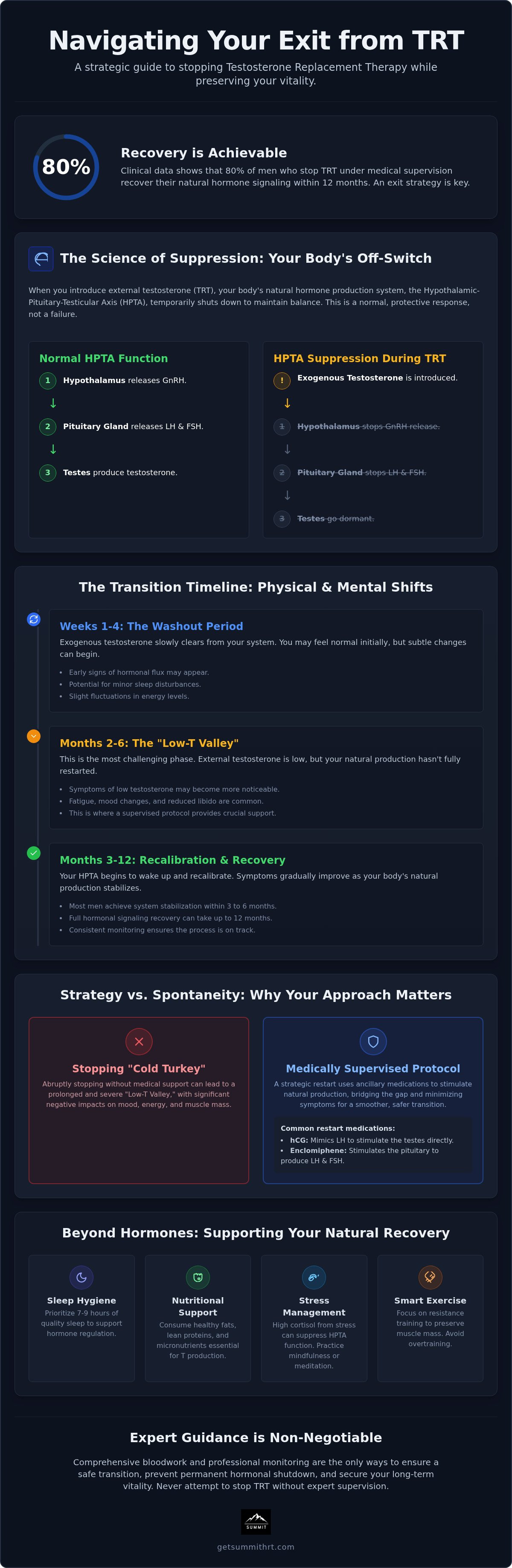
This guide offers a clear roadmap for navigating the transition off testosterone replacement therapy safely. We will explore the physiological shifts your body undergoes as your natural HPG axis restarts, alongside the specific medical protocols used to minimize symptoms. Clinical data suggests that 80% of men who stop under medical supervision recover their natural hormone signaling within 12 months. We will preview the typical 3 to 6 month recovery timeline, the role of restart medications like hCG or Enclomiphene, and the essential lifestyle habits that help you preserve your muscle and mood during this vital transition.
Table of Contents
The Science of Suppression: Why Your Body Reacts When TRT Stops
The Timeline of Transition: Physical and Mental Shifts to Expect
Strategy vs. Spontaneity: Why Tapering and Restart Protocols Matter
Beyond Hormones: Supporting Recovery Through Precision Health
Navigating Your Hormonal Future: Why Expert Guidance is Non-Negotiable
The Science of Suppression: Why Your Body Reacts When TRT Stops
The human body is a masterpiece of efficiency, constantly adjusting its internal chemistry to maintain a state of balance called homeostasis. When you introduce external hormones through Androgen replacement therapy, your body recognizes the abundance and reacts logically. It pauses its own production to prevent an overload. This biological "off switch" is the root of most concerns regarding what happens when you stop taking trt. It isn't a sign that your system is failing; it's a sign that your system is listening.
This process is managed by the Hypothalamic-Pituitary-Testicular Axis (HPTA). This feedback loop acts like a thermostat. When testosterone levels are high, the hypothalamus stops releasing Gonadotropin-Releasing Hormone (GnRH). Without GnRH, the pituitary gland ceases production of Luteinizing Hormone (LH) and Follicle-Stimulating Hormone (FSH), the messengers that tell your testes to work. This is temporary suppression. The depth of this suppression depends heavily on how long you've been on therapy and the dosages used. Longer durations lead to a deeper "sleep" for the HPTA, which requires a more deliberate wake-up call during the transition.
Understanding the HPTA Shutdown
Think of the HPTA shutdown as a muscle that hasn't been used in a while. It's not broken, but it has certainly weakened from disuse. During TRT, the absence of LH and FSH signals means the natural machinery is effectively in a dormant state. The challenge of cessation isn't just about the testosterone leaving your system. It's about the delay between the external hormone disappearing and the brain realizing it needs to start the GnRH signal again. Resting the system is a natural part of therapy, but restarting it requires a strategic approach to bridge this communication gap.
Factors Influencing Your Recovery Potential
Your ability to bounce back isn't a matter of luck. It's a result of specific biological variables. Your age and baseline health before starting therapy are the strongest predictors of how quickly your HPTA will resume normal function. Younger men often see a more rapid return of LH pulses compared to those with more advanced age-related declines. Research shows that about 80% of men who stop under medical supervision recover adequate hormonal signaling within 12 months, though the first few months are the most critical.
Another factor is testicular atrophy. If the testes have physically shrunk due to a prolonged lack of signaling, the restart timeline may be extended. This is why a professional trt therapy plan should prioritize an exit strategy from the very first day. Understanding these mechanics allows us to use precision tools like hCG to maintain testicular sensitivity even while on therapy, which makes the eventual transition much smoother and more predictable.
The Timeline of Transition: Physical and Mental Shifts to Expect
Transitioning off therapy is a chronological journey rather than a sudden event. Understanding what happens when you stop taking trt requires looking at the "washout" and "recalibration" phases as distinct stages. Each phase presents unique challenges to your physical and mental well-being as your body shifts from external support back to internal production. Most men who follow a supervised protocol find that their system fully stabilizes within three to six months, though the intensity of this experience varies based on your previous dosage and duration of treatment.
Weeks 1–4: The Initial Decline
The first month is defined by the "washout period." If you were using Testosterone Cypionate, the medication has a half-life of roughly eight days. It takes about six weeks for the exogenous hormone to fully clear your system. During these initial weeks, you may feel relatively normal as levels slowly taper off. However, early signs of hormonal flux, such as sleep disturbances and slight energy fluctuations, often begin to surface toward the end of week four. Bloodwork isn't usually helpful in this first month because levels are still in flux; testing too early often leads to unnecessary anxiety rather than actionable data.
Months 2–6: The Recalibration Phase
This period is often called the "Low-T Valley." It's the point where exogenous levels have dropped significantly, but your natural production hasn't fully resumed. This is when psychological shifts like brain fog and irritability become more prominent. You might also notice changes in your physical state, such as a slight metabolic slowing or a decrease in gym recovery. The psychological impact often feels like a temporary dimming of your drive. You might find yourself more reactive to stress or struggling to focus on complex tasks. It's a critical time to maintain your "mental game" and resist the urge to restart therapy prematurely.
Monitoring biological markers is essential here. The return of morning erections and a stabilizing libido are excellent signs that your Luteinizing Hormone (LH) is recovering. To protect your body composition, many patients ask, are peptides good for you during this transition? Peptides can be instrumental in preserving muscle mass and supporting metabolic health while your hormones stabilize. Our medical team often integrates these tools to prevent the muscle loss that can occur when testosterone is temporarily low. Navigating this valley requires patience and professional oversight. If you're concerned about your specific timeline, scheduling a telehealth consultation can provide the professional reassurance you need to stay the course.
Strategy vs. Spontaneity: Why Tapering and Restart Protocols Matter
Stopping hormone therapy abruptly is a gamble with your biological stability. When you choose a "cold turkey" approach, you force your body into an acute hormonal crash. The exogenous testosterone leaves your system quickly, but your internal production remains dormant. This gap creates a period of profound fatigue, mood instability, and physical weakness. Understanding what happens when you stop taking trt without a plan is the first step in realizing that a clinical restart protocol isn't just an option; it's a necessity for preserving your long term vitality.
A professional Post-Cycle Therapy (PCT) aims to bridge this gap. Instead of waiting for the brain to wake up on its own, we use specific medications to signal the system to resume production. Human Chorionic Gonadotropin (hCG) plays a vital role here by mimicking Luteinizing Hormone (LH), which directly stimulates the Leydig cells in the testes. This prevents or reverses atrophy and ensures the "machinery" is ready to work before we ask the brain to take over the controls. Following this, Selective Estrogen Receptor Modulators (SERMs) like Enclomiphene or Clomid are used to encourage the pituitary gland to release its own LH and FSH.
The Clinical Restart Protocol
A successful transition follows a methodical, three step sequence. First, we implement a gradual tapering of testosterone esters. This slow reduction prevents the "cliff effect" where levels drop too fast for the body to compensate. Second, we introduce LH-mimicking agents to ensure testicular sensitivity is maintained. Finally, we transition the patient to oral medications that block estrogen's negative feedback on the brain. This final step stimulates the natural production of Gonadotropin-Releasing Hormone (GnRH), completing the loop and allowing your HPTA to function independently once again.
Monitoring Success with Data
Precision is the hallmark of a safe exit. You cannot guess your way through a hormonal recalibration. Frequent bloodwork is the only tool that verifies your system is coming back online. We monitor not just total testosterone, but also estrogen and Sex Hormone-Binding Globulin (SHBG) levels. Fluctuations in these markers can stall your progress or cause unwanted side effects like water retention or irritability. If estrogen spikes while testosterone is still low, the protocol must be adjusted immediately to keep the recovery on track.
Managing this process doesn't require constant office visits. The rise of hrt online has made professional monitoring more accessible than ever. Through telehealth consultations and direct to home medication delivery, we can guide you through every bloodwork adjustment from the comfort of your home. This level of oversight ensures that your transition is based on real time data rather than a generic timeline, giving you the best possible chance at a full and permanent recovery.
Beyond Hormones: Supporting Recovery Through Precision Health
The strategy for a successful exit extends far beyond the pharmacy. While clinical protocols provide the necessary spark, your body needs the right biological environment to sustain its own production. What happens when you stop taking trt is largely influenced by how you manage your internal environment during the recalibration phase. Precision health involves aligning your nutrition, sleep, and activity levels to support the delicate return of your natural hormonal pulses.
Nutritional Foundation: Focus on dietary cholesterol and healthy fats. These are the raw materials for steroid hormone production. Avoid low-fat diets during this window.
Micronutrient Optimization: Zinc, Vitamin D, and Magnesium act as essential cofactors in testosterone synthesis. Deficiencies in these areas can stall HPTA recovery.
Sleep Architecture: Natural Luteinizing Hormone (LH) and Growth Hormone (GH) pulses are heavily dependent on deep sleep cycles. Prioritize a consistent 7 to 9 hour window to maximize these natural bursts.
Training Adjustments: Shift from high-intensity, high-volume sessions to recovery-focused movements. Overtraining can spike cortisol, which suppresses the signals your brain is trying to send to your testes.
Metabolic Support and Peptides
One of the most common anxieties during a transition is the fear of metabolic slowing and fat gain. When testosterone levels dip, insulin sensitivity often decreases, making it easier for the body to store adipose tissue. Utilizing peptides for weight loss can be a strategic way to maintain your body composition while your hormones stabilize. Growth Hormone Secretagogues can also bridge the energy gap, providing the vitality needed to stay active without overtaxing your nervous system as you navigate the typical 3 to 6 month recovery timeline for the HPG axis.
Stress Management and Cortisol
Cortisol and testosterone share an inverse relationship. When stress levels are high, your body prioritizes survival over reproduction, effectively shutting down the HPTA signals you are trying to restore. Understanding what happens when you stop taking trt involves recognizing that your nervous system is as much a part of the equation as your endocrine system. Practical mindfulness and breathwork are tools to stabilize the nervous system and keep cortisol in check.
Pushing through extreme fatigue with caffeine or sheer willpower can backfire by keeping your stress hormones elevated. Respecting your body's need for rest is a non-negotiable part of the recovery process. If you want a tailored plan that looks at your labs and your lifestyle as one cohesive system, connect with our precision health experts today.
Navigating Your Hormonal Future: Why Expert Guidance is Non-Negotiable
Attempting to stop therapy on your own is like navigating a complex flight path without a radar. While your body has an incredible capacity for recovery, the risk of a permanent hormonal shutdown is a real possibility if the transition isn't handled with clinical precision. Most people only begin to wonder what happens when you stop taking trt after they've already hit the "low-T valley" we discussed earlier. By then, the system is already under significant stress. Expert guidance ensures that your hormones don't just "crash and hope," but instead follow a controlled descent toward a healthy, natural baseline.
Personalized data is the only tool that removes the guesswork from this process. We don't rely on generic timelines because your HPG axis responds to cessation based on your unique biology. Beyond the restart protocol, this transition is an opportunity to pivot your focus toward other wellness modalities. Many patients successfully move from TRT into optimized regimens involving precision vitamins and peptides to maintain their energy. This shift allows you to stay proactive about your health without necessarily remaining on exogenous testosterone indefinitely.
The Summit Rejuvenation Approach
Our philosophy centers on a concept we call "Precision Vitality." We don't just fill a prescription; we manage your entire hormonal lifecycle. This is why summit rejuvenation utilizes comprehensive bloodwork analysis as a mandatory requirement for every stage of your journey. Whether you're starting, tapering, or transitioning to a new wellness protocol, we use real time data to guide every decision. Through our telehealth platform, you have direct access to experts who understand the subtle nuances of hormonal shifts, ensuring you feel supported and informed at every turn.
Next Steps for Your Vitality
If you're considering a transition, the first step is a collaborative conversation about your long term goals. You can schedule a telehealth consultation to review your history and discuss which restart medications or metabolic supports are right for you. Before your appointment, we will coordinate your comprehensive bloodwork. When you head to the lab, you can expect a thorough panel that looks at your total and free testosterone, LH, FSH, and metabolic markers. This data serves as our roadmap for your recovery.
Reclaiming your natural vitality is a journey that requires patience, but you don't have to walk that path alone. With the right medical partnership, the transition off TRT can be a smooth, manageable process that preserves your hard earned progress. We're here to ensure that your hormonal future is one of clarity, strength, and lasting health.
Secure Your Long-Term Hormonal Vitality
Navigating the end of a therapy cycle is a significant milestone that requires a shift from replacement to restoration. By understanding what happens when you stop taking trt, you can approach the transition with confidence rather than apprehension. Success hinges on a methodical restart protocol that uses clinical data to bridge the gap between exogenous support and your natural hormonal pulses. Whether you're prioritizing fertility or simply shifting your wellness goals, a structured exit strategy protects your muscle mass and mental clarity.
You don't have to manage this complex biological recalibration alone. Summit Rejuvenation provides the specialized telehealth consultations and comprehensive bloodwork analysis necessary to ensure your system returns to a healthy baseline. With direct-to-home medication shipping for your restart protocol, we make professional oversight seamless and accessible. Your journey toward lasting vitality is a collaborative process, and we're dedicated to guiding you through every stage of your hormonal health.
Frequently Asked Questions
Is it dangerous to stop TRT cold turkey?
Stopping cold turkey isn't usually life-threatening, but it leads to a profound hormonal crash that can be mentally and physically draining. Without a gradual taper, your body is left with near-zero testosterone for several weeks while the brain's signaling remains dormant. This often results in extreme fatigue, irritability, and a total loss of libido. We strongly recommend a supervised restart protocol to ensure a smoother transition and minimize these acute withdrawal symptoms.
Will my testicles return to their normal size after stopping TRT?
Yes, your testicles will typically return to their normal size once the body's natural signaling resumes. When you stop therapy, the return of Luteinizing Hormone (LH) tells the testes to begin producing testosterone and sperm again. This process can be accelerated by using hCG during the transition. While the timeline varies, most men see a noticeable improvement in testicular volume within a few months of following a proper restart plan.
How long does it take for natural testosterone to return?
Most men recover their natural production within 3 to 6 months when following a supervised medical protocol. However, research indicates that about 80% of men who stop under medical supervision recover adequate hormonal levels within 12 months. The specific timeline depends on your age, baseline health, and how long you were on therapy. Understanding what happens when you stop taking trt helps you set realistic expectations for this multi-phase recalibration.
Can I use HCG while I am still on TRT to make stopping easier later?
Using hCG while still on therapy is an excellent strategy to make a future transition much easier. It works by mimicking LH, which keeps the Leydig cells in the testes active even while exogenous testosterone is present. This prevents testicular atrophy and ensures the machinery is ready to work immediately when you decide to stop. It's a proactive step that many of our patients use to maintain their long term fertility.
Will I lose all my muscle gains if I stop taking testosterone?
You won't lose all your muscle gains, but you should expect some changes in body composition. Much of the immediate "loss" is actually water weight and glycogen that testosterone helps the muscles retain. To preserve your hard-earned lean mass, you must prioritize high-protein nutrition and recovery-focused strength training. Using specific peptides can also help bridge the gap, preventing the metabolic slowing that sometimes occurs as your natural levels stabilize.
What are the first signs that my natural testosterone is coming back?
The return of morning erections and a stabilizing libido are the most reliable early signs that your natural production is resuming. These biological markers indicate that your brain is successfully sending LH signals to your testes again. You might also notice a gradual lift in your overall mood and a reduction in the "brain fog" that often characterizes the low-T valley. Tracking these shifts provides the encouragement needed to stay the course.
Do I need to take Clomid when I stop TRT?
While not every patient needs Clomid, it is a standard component of many clinical restart protocols. Selective Estrogen Receptor Modulators (SERMs) like Clomid or Enclomiphene work by blocking estrogen's negative feedback on the brain. This encourages the pituitary gland to release more LH and FSH, which are the essential messengers for natural testosterone production. We use comprehensive bloodwork to determine if these medications are necessary for your specific hormonal profile.
Can peptides help with the fatigue after stopping TRT?
Peptides can be highly effective at managing the fatigue and metabolic shifts that occur when you stop hormone therapy. Growth hormone secretagogues, for instance, help support energy levels and insulin sensitivity during the recalibration phase. To explore specialized research tools that assist with these protocols, read more. This is a key part of what happens when you stop taking trt under professional care; we use these ancillary tools to ensure you remain functional and vibrant while your HPTA axis slowly returns to its natural state.


Comments