Exercise for Max TRT Results: 2026 Performance Guide
Updated: Sep 1
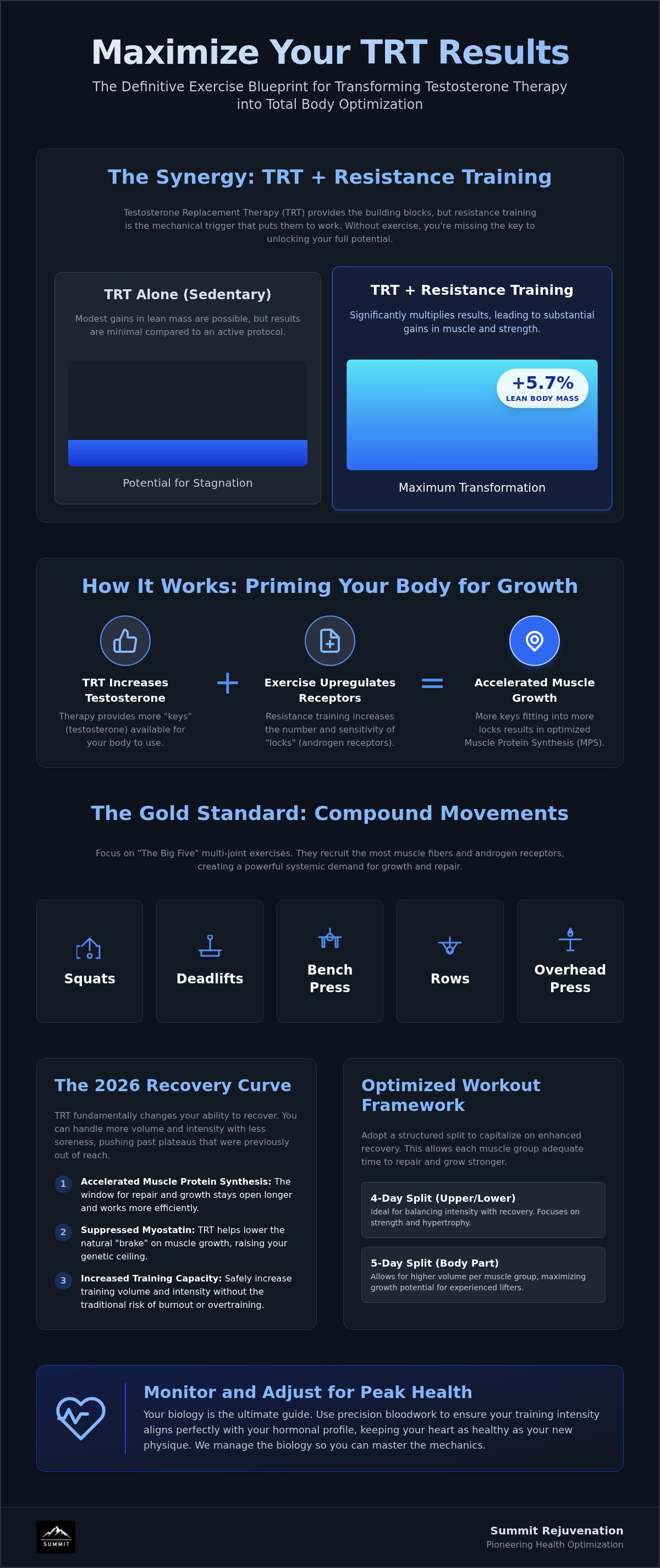
You have optimized your hormones, but without the right mechanical stimulus, you're essentially idling a high-performance engine in a school zone. It's a common frustration to start therapy and still feel like your gym progress is lagging behind your expectations. You likely understand that finding the right exercise to maximize trt results is the missing piece of the puzzle. While 2026 research indicates that injectable TRT can increase lean body mass by 5.7 percent, those gains don't happen in a vacuum; they require a deliberate physical trigger to manifest.
We understand the confusion of balancing heavy sets with heart health or the fear of overtraining when you finally feel invincible again. You deserve a roadmap that respects your biology and your time. This guide reveals the specific training protocols that transform your treatment into a total body transformation. We will break down how to prioritize resistance training for muscle gain, utilize strategic cardio for fat loss, and use your bloodwork as a compass to ensure your heart stays as healthy as your new physique.
Table of Contents
The Biological Synergy: Why Exercise is Mandatory for TRT Success
Testosterone replacement therapy provides your body with the essential building blocks for restoration, but it doesn't provide the blueprint. Think of your therapy as a delivery of high-grade lumber to a construction site. Without a crew of builders and a clear set of architectural plans, that lumber simply sits in the yard. In this biological equation, your workout routine is the blueprint. Choosing the right exercise to maximize trt results ensures that the hormones you're receiving are actually put to work at the cellular level. TRT is a biological force multiplier for every ounce of physical effort you exert.
A primary reason exercise is non-negotiable involves your androgen receptors. These are the "locks" that testosterone "keys" must fit into to trigger muscle growth and fat loss. Research into Androgen replacement therapy suggests that while exogenous testosterone increases the available "keys," resistance training is what increases the density and sensitivity of the "locks." By training consistently, you're making your body more receptive to the therapy. If you remain sedentary, you're essentially leaving potential gains on the table because your cells aren't primed to receive the hormonal signal.
Testosterone as a Force Multiplier
Once you begin therapy, your body's ability to recover changes fundamentally. Testosterone significantly accelerates Muscle Protein Synthesis (MPS) following a difficult training session. This means the window where your body repairs and grows new tissue stays open longer and operates more efficiently. Additionally, optimized testosterone levels help suppress myostatin, a protein that naturally acts as a "brake" on muscle growth. By lowering this barrier, you can push past plateaus that previously felt permanent. Your "floor" for maintaining muscle mass is now higher, but your "ceiling" for growth has also been elevated. You'll find that you can handle more intensity while experiencing less of the lingering soreness that used to sideline you for days.
Avoiding the Sedentary Trap
It's a common myth that TRT is a "magic pill" that builds a physique while you sit on the couch. While 2026 data shows that even sedentary men on TRT can see modest increases in lean mass, the results pale in comparison to those who are active. In fact, a sedentary lifestyle while on therapy can be counterproductive. Optimized testosterone often increases appetite and energy; without a physical outlet, that extra caloric intake can easily turn into visceral fat. Regular muscle contraction is also the most effective way to maintain high insulin sensitivity, ensuring that nutrients are shuttled into your muscles rather than stored as adipose tissue. Your bloodwork might show perfect numbers, but those numbers don't reflect your actual physical capability or body composition. We manage the biology so you can master the mechanics in the gym.
Resistance Training: The Gold Standard for TRT Results
While general cardiovascular activity supports metabolic health, resistance training is the primary tool for harnessing testosterone's anabolic potential. It stands as the definitive exercise to maximize trt results because it forces your body to adapt by synthesizing new muscle tissue rather than just maintaining the status quo. Research supports this biological shift; one meta-analysis of 31 randomized controlled trials found that injectable TRT can increase lean body mass by 5.7 percent. By building more lean mass, you create a larger metabolic engine. This larger engine helps stabilize your hormonal profile over the long term and improves your overall insulin sensitivity.
To see significant changes, your program must center on "The Big Five" compound movements: Squats, Deadlifts, Bench Press, Rows, and Overhead Press. These movements are essential because they recruit a vast number of androgen receptors across multiple muscle groups simultaneously. This creates a systemic demand for repair and growth that isolation exercises simply cannot match. Focusing on these foundational lifts builds a solid base of strength and vitality that serves as the cornerstone of your transformation.
Compound Movements for Maximum Hormonal Response
Multi-joint movements do more than just build muscle. They provide a unique benefit to your central nervous system (CNS) by improving the efficiency of your neuromuscular connections. This leads to better coordination and higher power output. However, it's vital to prioritize form over the weight on the bar. While you might feel "invincible" on therapy, your tendons and ligaments need time to catch up to your rapidly increasing muscle strength. If you find your joints aren't keeping pace with your gains, you can learn more about mobile regenerative medicine for recovery. Safety is paramount to ensure your progress remains sustainable and injury-free.
For most patients, the 8 to 12 rep range remains the gold standard for achieving a mature, vital physique. This range optimizes "time under tension" (TUT), which is critical for triggering sarcoplasmic growth and improving muscle density. Because your recovery speed is significantly enhanced, you can move away from traditional "bro-splits" and hit each muscle group more frequently, perhaps twice per week. This increased frequency allows you to capitalize on the elevated muscle protein synthesis we discussed earlier. Balancing these protocols requires a clear understanding of your current physiological state. If you aren't sure how your body is responding to this increased intensity, getting a comprehensive bloodwork analysis can help us tailor your protocol to your specific training goals.
Optimizing Volume and Recovery in 2026
One of the most immediate shifts you'll notice on therapy is the compression of your recovery window. In 2026, we recognize that the traditional advice to rest 48 hours between sessions is often too conservative for those with optimized hormones. While your low-T peers might struggle with systemic fatigue after a heavy leg day, your body repairs micro-tears in muscle tissue with significantly greater efficiency. This accelerated repair cycle is a primary reason to adjust your exercise to maximize trt results. By increasing your weekly training volume through more sets or higher frequency, you capitalize on the fact that your muscle protein synthesis remains elevated for longer durations.
Your hormonal profile now acts as a protective shield against the catabolic effects of cortisol. In a natural state, intense training spikes cortisol, which can eventually lead to muscle breakdown if the stress isn't managed. Optimized testosterone levels improve your testosterone-to-cortisol ratio, allowing you to handle higher workloads without the typical risk of "crashing." However, this isn't a license to ignore your body's fundamental needs. Sleep remains the silent partner in this process. Most tissue repair and growth occur during deep sleep cycles; without seven to nine hours of quality rest, you are essentially blunting the effectiveness of your protocol.
The Progressive Overload Mandate
TRT provides the physiological stability needed to pursue aggressive progressive overload. You should find yourself able to add weight to the bar or perform additional repetitions more frequently than was possible in the past. We recommend tracking every lift meticulously because your training log serves as a vital diagnostic tool for your overall health. If your strength isn't increasing over a four-week block, it's a clear signal that your nutrition or your current protocol needs adjustment. We view your performance in the gym as a leading indicator that works in tandem with your clinical data.
Strategic Recovery for Longevity
While your muscles might feel ready for a second workout, your connective tissues often require more time to adapt. It's common for muscle strength to outpace tendon durability during the first few months of therapy. To manage this, we prioritize active recovery over total rest. Low-intensity walking and mobility work keep blood flowing to recovering tissues without adding to your systemic load. For a deeper look at how these lifestyle factors integrate into a long-term plan, see our TRT Therapy: The Comprehensive Guide. Balancing high-intensity effort with smart recovery ensures you don't just get strong quickly, but stay strong for years to come.
Designing Your TRT-Optimized Workout Framework
Building a framework for your training ensures you aren't just working hard, but working with precision. Now that your recovery window has compressed, your exercise to maximize trt results must shift toward a higher frequency model. We recommend a structured 4-day or 5-day split to provide the ideal balance between stimulus and rest. By moving away from a traditional once-a-week body part "blast," you can hit muscle groups more often, taking full advantage of your body's enhanced protein synthesis. Prioritizing 'Push/Pull/Legs' or 'Upper/Lower' frameworks allows for this balanced growth while preventing systemic fatigue.
A complete framework also requires a feedback loop. Your training intensity shouldn't be static; it should evolve based on your quarterly bloodwork results. If your labs indicate your biomarkers are stable, you have the green light to push for new personal records. However, if indicators like hematocrit are climbing, we may suggest shifting focus toward more cardiovascular work. This collaborative approach ensures that your gym performance serves as a leading indicator of your overall health, allowing us to manage the biology while you master the mechanics.
The 4-Day Power-Hypertrophy Split
This specific split is designed to maximize receptor stimulation without causing burnout. The schedule typically looks like this:
Day 1: Upper Body Power (Heavy compound movements)
Day 2: Lower Body Power (Squats or deadlifts for strength)
Day 3: Rest or Zone 2 Cardio
Day 4: Upper Body Hypertrophy (Higher reps, 8-12 range)
Day 5: Lower Body Hypertrophy (Isolation and volume focus)
This structure allows you to train for both raw strength and muscle size in the same week. By separating power days from hypertrophy days, you give your central nervous system time to recover while keeping your muscles in a constant state of growth.
Zone 2 Cardio: The TRT Heart Health Insurance
One area often ignored in TRT circles is the necessity of cardiovascular health. Because testosterone can increase red blood cell production, managing blood thickness is vital for long-term safety. Aiming for 150 minutes of Zone 2 cardio per week is your best "insurance policy." Zone 2 is low-intensity steady-state work where you can still hold a conversation. It improves your lipid profile and heart health without the massive recovery tax of High-Intensity Interval Training (HIIT). While HIIT has its place, Zone 2 is superior for TRT patients because it supports recovery rather than competing with your lifting sessions for energy. To ensure your training and therapy are perfectly aligned, you can start your comprehensive bloodwork analysis today to monitor these critical health markers.
Monitoring Progress with Summit Rejuvenation
Your journey doesn't end once your prescription arrives at your door; it truly begins when we start fine-tuning your protocol based on real-world feedback. We view your performance in the gym as a leading indicator for dosage adjustments. If you've implemented the right exercise to maximize trt results but find your energy flagging or your strength plateauing, your biology is sending us a signal. This is why we prioritize regular, comprehensive bloodwork analysis to monitor critical markers like lipids, hematocrit, and estradiol. These numbers tell the story of how your body is responding to the increased physical demand of your new training volume.
Effective hormone optimization requires a partnership built on transparency. During your telehealth consultations, we encourage you to move beyond generalities. Tell us about your gym PRs, your recovery speed, and your subjective energy levels throughout the day. By communicating your specific training goals, our medical providers can adjust your protocol to ensure your hormones are supporting your ambitions rather than holding them back. We manage the delicate internal chemistry so you can focus on mastering the mechanics of your transformation.
Precision Vitality: Beyond the Numbers
In 2026, the standard of care has shifted from simply reaching "normal" lab ranges to achieving "optimal" performance levels. A lab result that is considered acceptable for a sedentary individual might be insufficient for someone training four to five days a week with high intensity. This is the core of our "Precision Vitality" philosophy. We also recognize that as your strength increases, your joints and connective tissues may require additional support. This is where the strategic use of peptides and vitamins can play a vital role in enhancing recovery and maintaining joint integrity alongside your primary therapy. For a deeper dive into our methodology, explore Summit Rejuvenation: The Comprehensive Guide.
Your Next Steps for Peak Performance
Maintaining peak performance requires proactive maintenance. We make it easy to schedule your follow-up labs through our national network of diagnostic centers, ensuring you never have to guess about your health status. As you prepare for your next consultation, keep a log of your energy, libido, and gym progress. This data allows us to make surgical adjustments to your protocol with confidence. If you're ready to move from standard treatment to precision optimization, the first step is a clear picture of your current internal landscape. Start your precision journey with a comprehensive bloodwork analysis and discover what your body is truly capable of achieving.
Mastering Your Physical Evolution in 2026
Your transformation requires both biological precision and mechanical effort. We've established that while optimized hormones provide the ideal environment for growth, your commitment to the right exercise to maximize trt results is what actually forces your body to adapt. By prioritizing compound resistance training and supporting your cardiovascular health with Zone 2 sessions, you ensure your therapy translates into visible, sustainable vitality. Your gym performance serves as a leading indicator of your internal health, working in tandem with your clinical data to guide your progress.
Summit Rejuvenation is here to serve as your dedicated partner in this journey. We provide comprehensive bloodwork-driven protocols and convenient telehealth access to hormone specialists, ensuring your care is as unique as your training goals. With nationwide direct-to-home shipping, we remove the logistical barriers so you can focus entirely on your performance. It's time to reclaim your vitality and see what your body can truly achieve when its biology is finally aligned with its potential. Schedule Your Telehealth Consultation with Summit Rejuvenation today and take the first step toward your peak self.
Frequently Asked Questions
Can I build muscle on TRT without working out?
While some research indicates that men with hypogonadism can see modest increases in lean body mass without lifting, you won't achieve a total body transformation sitting on the couch. Testosterone provides the hormonal signal for growth, but your muscles need a physical reason to adapt. Without resistance training, you're more likely to experience weight gain from increased appetite rather than the significant muscle definition you're likely seeking.
What is the best type of exercise for someone on TRT?
Resistance training focused on compound movements like squats, deadlifts, and presses is the most effective exercise to maximize trt results. These multi-joint exercises recruit the highest number of muscle fibers and androgen receptors simultaneously. By creating a systemic demand for repair, you leverage your optimized hormones to build a dense, powerful physique that isolation exercises alone simply cannot produce.
How often should I lift weights while on testosterone therapy?
Most patients find that a 4-day or 5-day lifting split is the ideal frequency for progress. Because your recovery window is significantly compressed on therapy, you can train more frequently than a low-T peer without feeling drained. This higher frequency allows you to hit each muscle group twice per week, which keeps muscle protein synthesis elevated and accelerates your physical development over time.
Does TRT make you stronger instantly?
You won't see an immediate spike in your strength the day after your first dose. While you might notice improved mental clarity and energy within the first week, actual contractile tissue growth takes time. Strength gains typically begin to manifest between weeks four and eight as your nervous system and muscle fibers adapt to the new hormonal environment and increased training intensity.
Is cardio necessary if I am lifting heavy on TRT?
Cardiovascular activity is essential for maintaining your long-term health while on therapy. Lifting heavy builds the engine, but cardio ensures the cooling system and fuel lines are working perfectly. Specifically, low-intensity Zone 2 cardio helps manage blood thickness and supports a healthy lipid profile. We recommend at least 150 minutes of steady-state activity per week to protect your heart as your strength increases.
Can I overtrain if I am on TRT?
It's still possible to overtrain, even when you feel invincible on therapy. While your muscles repair faster, your central nervous system and connective tissues like tendons still require adequate rest. Pushing too hard without scheduled recovery days can lead to joint inflammation or burnout; to learn more about how specialists handle these athletic risks, you can discover The Orthopaedic & Sports Medicine Institute. We use your comprehensive bloodwork to monitor markers like systemic inflammation, ensuring your training volume stays within a healthy range.
Most men report a noticeable increase in gym energy and muscle fullness within the first three to four weeks. However, significant changes in body composition, such as visible muscle gain and reduced body fat, usually take three to six months of consistent effort. Your results depend heavily on the synergy between your prescribed protocol, your nutrition, and your dedication to a structured training framework.
Should I change my diet when I start exercising on TRT?
Adjusting your nutrition is vital to support the metabolic changes triggered by your protocol. As your muscle protein synthesis increases, your body requires more high-quality protein and a balanced intake of healthy fats and carbohydrates. You'll often find that a slight increase in caloric intake is necessary to fuel your new training intensity, provided those calories come from nutrient-dense sources that support your overall vitality.


Comments