Getting a Second Opinion on Hormone Levels: Why 'Normal' Isn't Always Optimal
Updated: Aug 27
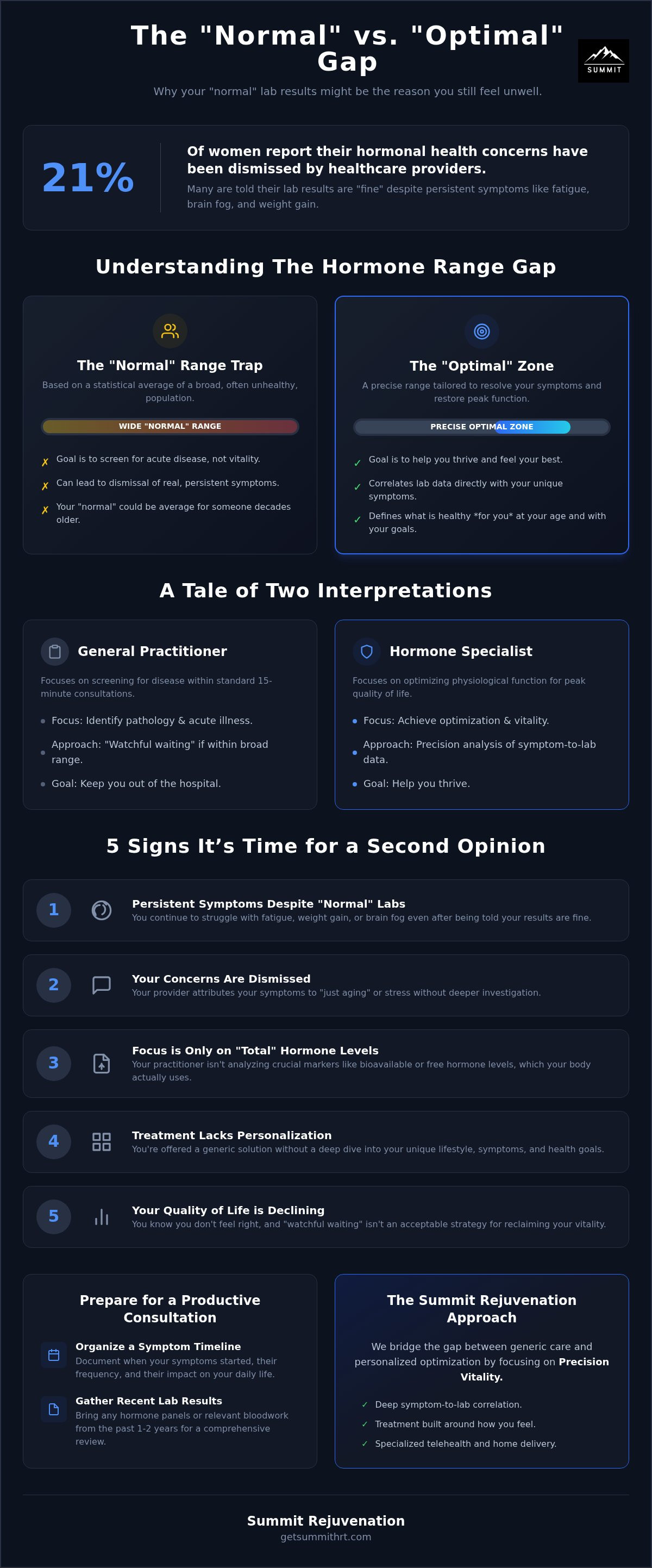
Did you know that 21% of women report their hormonal health concerns have been dismissed by healthcare providers, often after being told their lab results are perfectly fine? If you are struggling with persistent fatigue, brain fog, or unexplained weight changes, hearing that your bloodwork is "normal" feels like a dead end. You know your body better than a statistical average. This is why getting a second opinion on hormone levels is often the most critical step toward reclaiming your vitality. It's frustrating to live with unresolved symptoms while a practitioner points to a "clean" report, but you aren't alone in feeling that these generic ranges don't reflect your reality.
We believe your care must be tailored to how you feel, not just a number on a page. This article explains why standard lab interpretations often miss the mark and how a specialized second opinion can bridge the gap between "normal" results and feeling your best. You'll learn about the limitations of traditional reference ranges and how a dedicated partner in health provides the validation you've been seeking. We'll outline a clear path toward symptom relief and a treatment strategy built around your unique needs, ensuring your journey back to wellness is both professionally managed and deeply personal.
Table of Contents
Why You Might Need a Second Opinion on Your Hormone Lab Results
The reality is that a general practitioner and a hormone specialist look at the same numbers through very different filters. While a primary care doctor is trained to spot pathology or immediate health crises, a specialist looks for optimization. Research shows that approximately 21% of women feel their hormonal health concerns have been dismissed by healthcare providers. This disconnect often stems from a lack of specialized training in how hormones interact to dictate your daily quality of life. A second opinion provides the validation that your symptoms are real and, more importantly, treatable.
Primary care physicians serve as the frontline of medicine, but their role is primarily to screen for acute illness and chronic disease. In a standard 15-minute consultation, there's rarely enough time to correlate subtle hormonal fluctuations with your specific symptoms. If your Thyroid function tests or testosterone markers fall anywhere within the broad reference range, a generalist might suggest "watchful waiting." However, waiting while your quality of life declines isn't a recovery strategy. It's a delay that ignores the underlying shifts a specialist would recognize as a clear call to action. Their goal is to keep you out of the hospital; our goal is to help you thrive.
Hormone Health is a Specialized Field
Hormone optimization requires a deep understanding of how different biological systems interact. Specialists dedicate their entire practice to staying current on advanced protocols, including the latest research on peptides for weight loss and modern TRT methodologies. This expertise is vital because hormone health isn't a one-size-fits-all discipline. A specialist listens to your subjective experience, treating the person rather than the paperwork. They understand that a level considered "normal" for an 80-year-old is likely insufficient for a 40-year-old seeking to reclaim their energy. This partnership ensures your treatment plan is built on precision, not just a statistical average.
Understanding the 'Normal' vs. 'Optimal' Hormone Range Gap
Standard lab results provide a reference range that represents a statistical average of everyone who visited that lab in recent years. This group often includes individuals managing chronic illnesses, metabolic disorders, or the natural decline of aging. Consequently, being "normal" simply means you aren't in the bottom 2.5% or top 2.5% of a potentially unhealthy population. Getting a second opinion on hormone levels shifts the focus from being "average" to being "optimal." Optimal levels are the specific ranges where your symptoms resolve, your energy returns, and your body functions at its peak. Understanding Hormone Tests is a vital part of this process, as it helps you realize that a lab report is just a starting point, not a final diagnosis.
Precision care recognizes that a 30-year-old shouldn't be held to the same standards as an 80-year-old. Many practitioners fail to account for the fact that "normal" ranges decline with age, effectively telling a young patient they have the hormone profile of someone decades older. We must also look beyond "total" hormone numbers. Your body primarily uses bioavailable hormones. If your total levels look fine but your bioavailable levels are low, you'll still feel the heavy weight of deficiency. Discover how a personalized hormone analysis can reveal what these standard tests miss.
How Lab Reference Ranges Can Mislead You
Lab diagnostics rely on a bell curve. If you fall even one point inside that curve, you're labeled healthy, even if you're suffering. Clinical deficiency refers to a total lack of hormone production requiring urgent medical intervention, whereas suboptimal performance describes levels that fall within standard ranges but fail to support peak physiological function and symptom relief. This distinction is the primary reason why patients feel dismissed. You don't have to wait for a total system failure to start feeling better.
The Importance of Comprehensive Bloodwork Analysis
A basic panel often ignores critical markers like Sex Hormone Binding Globulin (SHBG), Estradiol, or Free Testosterone. Without these, you only see a fraction of the picture. A specialist uses a wider lens to understand how these hormones interact. For a deeper look at what a truly thorough review looks like, you can explore Summit Rejuvenation's guide to bloodwork. Getting a second opinion on hormone levels ensures that every relevant marker is analyzed to build a strategy for your specific biology.
5 Signs It’s Time to Seek a Specialist for Your Hormone Health
Recognizing when your current medical care has reached its ceiling is the first step toward true restoration. While primary care providers are excellent at managing acute illness, they often lack the specific tools required for precision hormone optimization. Identifying these red flags can help you decide if getting a second opinion on hormone levels is the right move for your long-term vitality. If you feel like a passenger in your own health journey rather than a partner, it's time to evaluate these five common signs.
Symptoms persist despite "clean" labs: You're still battling chronic fatigue, stubborn weight gain, or a vanishing libido, even though you've been told your bloodwork is fine.
Hesitancy around modern treatments: Your current doctor is reluctant to discuss TRT therapy or bioidentical HRT, often citing outdated studies or a "wait and see" approach.
Misplaced prescriptions: Instead of investigating your endocrine system, you were offered antidepressants, anti-anxiety meds, or sleep aids to treat the symptoms of a hormonal imbalance.
Stagnant treatment plans: Your protocol hasn't changed in months or years, and your provider doesn't adjust dosages based on how you actually feel.
A gap in innovation: You want to explore advanced options like peptides for tissue repair or metabolic health, but your practitioner isn't familiar with these clinical tools.
Leading medical organizations have highlighted the importance of proper hormone screening to identify underlying conditions that standard checkups often overlook. Relying on a generic screening process can leave you stuck in a cycle of maintenance rather than improvement.
When Your Symptoms Don't Match Your Paperwork
There's a significant psychological toll in being told "nothing is wrong" when you feel fundamentally unwell. A specialist understands that the primary diagnostic tool should always be the patient's subjective experience, not just a lab slip. Getting a second opinion on hormone levels provides the clinical validation that your struggle is real. By treating the individual rather than the paperwork, a specialist can identify subtle deficiencies that fall within "normal" ranges but fail to support your specific biological needs.
Evaluating Your Current Treatment’s Effectiveness
Many patients settle for "feeling okay" because they don't realize that "thriving" is an option. If your current HRT protocol feels improperly balanced or generic, it's likely because it hasn't been fine-tuned to your unique metabolic rate and lifestyle. A second opinion allows for a deep dive into your data to adjust dosages and delivery methods. This precision ensures your treatment plan evolves alongside your body, moving you away from basic symptom management toward a state of reclaimed energy and focus.
How to Prepare for Your Hormone Therapy Second Opinion
For readers pursuing specialized goals such as feminization, you can discover Transfemme to find natural supplement formulas designed to support these unique physical transitions alongside your professional hormone care.
Preparation is the bridge between a generic consultation and a life-changing treatment plan. When you're getting a second opinion on hormone levels, the quality of your outcome is directly tied to the clarity of the information you share. Your new specialist needs to see the full picture of your physiology to identify the subtle gaps your previous doctor might have missed. Start by gathering your most recent bloodwork results, ideally from the last three to six months. These records serve as a baseline, allowing a specialist to track trends rather than just looking at a single point in time.
Next, create a detailed "Symptom Timeline." Instead of just saying you feel tired, try to pinpoint when the fatigue began and how it has evolved. Did it coincide with a change in weight, mood, or cognitive function? This narrative helps a specialist correlate your lab data with your lived experience. You should also list every supplement, medication, and previous hormone treatment you've tried. Being transparent about past "failed" protocols is incredibly valuable. It prevents the new specialist from repeating strategies that didn't work and helps them pivot toward a more effective approach.
Finally, define your specific objectives. Are you seeking mental clarity, muscle preservation, or perhaps hormone replacement therapy for women to manage menopause symptoms? Knowing your desired outcome allows the provider to build a protocol that targets your personal goals. If you're ready to move beyond generic care, you can schedule a comprehensive bloodwork review to start your journey with a specialist who listens.
Organizing Your Medical History for Clarity
Telehealth has streamlined the process of sharing medical data, but it requires you to be organized. Having digital copies of your bloodwork ready for a quick upload ensures your specialist can review your history before your consultation begins. Don't overlook lifestyle factors like sleep quality and stress levels. These elements often act as "force multipliers" for hormonal issues. Sharing this context allows the specialist to see you as a whole person, ensuring that your treatment plan accounts for your real-world environment.
Key Questions to Ask Your Second Opinion Specialist
A second opinion is a collaborative process. You should feel empowered to lead the conversation with specific, high-value questions. Start by asking: "Based on my symptoms, what markers are we missing in my current labs?" This helps identify if a more comprehensive panel is needed to see the full picture. Next, ask: "What does an optimal range look like for someone of my age and activity level?" This directly addresses the gap between being "normal" and feeling your best. Finally, ensure there is a follow-up plan by asking: "How will we monitor and adjust my plan over the first 90 days?" This ensures your care is dynamic and responsive to your feedback as your body begins to balance.
Precision Vitality: The Summit Rejuvenation Approach to Lab Interpretation
Summit Rejuvenation operates on the principle that your bloodwork is a map, but your symptoms are the compass. Getting a second opinion on hormone levels through our specialized framework ensures that we don't just look for what is missing; we look for what is possible. Our methodology relies on deep symptom-to-lab correlation, a process where we weigh your subjective experience just as heavily as the data from your comprehensive bloodwork analysis. This approach eliminates the "cookie-cutter" protocols often found in traditional clinics, replacing them with a precision-based strategy tailored to your unique metabolic profile.
The logistics are designed to respect your time and prioritize your comfort. You'll complete your lab work at a convenient local facility, and the results are then reviewed by our experts via a national telehealth consultation. This model removes the barriers of travel and long wait times, allowing you to access high-level expertise from your own home. Once your personalized plan is established, we handle the fulfillment by shipping your medications directly to your door. This seamless experience ensures that your focus remains on your recovery, not on managing logistics.
The Power of Specialized Telehealth
Access to elite hormone specialists shouldn't depend on your zip code. By utilizing online HRT, Summit provides a digital-first model that makes ongoing monitoring and support incredibly efficient. You can message your care team, adjust your protocol, and track your progress without ever stepping foot in a waiting room. Summit focuses on a long-term partnership rather than transactional care, ensuring you have a dedicated mentor throughout every phase of your rejuvenation.
Moving from 'Normal' to 'Optimal'
Your first consultation after your second opinion labs are in is where the transformation begins. We'll walk you through your results marker by marker, explaining how your levels relate to the brain fog, fatigue, or weight gain you've been experiencing. Our strategies often integrate peptides, vitamins, and hormones to create a total rejuvenation effect that addresses the root causes of your symptoms. Getting a second opinion on hormone levels is the decisive moment when you stop accepting "average" and start demanding excellence. Take control of your health journey today; the vitality you've been missing is well within reach through a plan built specifically for you.
Take the Final Step Toward Optimal Health
You don't have to settle for feeling "fine" when your body is capable of feeling exceptional. We've explored how standard lab ranges often fail to account for individual vitality and why your symptoms should always lead the diagnostic process. By getting a second opinion on hormone levels, you shift from being a statistic to being a priority. This specialized approach ensures your treatment is as unique as your biology, bridging the gap between a clean lab slip and real-world results.
Summit Rejuvenation offers the specialized expertise in symptom-to-lab correlation needed to decode your unique hormonal profile. Through convenient national telehealth consultations and direct-to-home medication delivery, we make precision care accessible and straightforward. It's time to stop accepting generic answers and start demanding a plan that reflects your potential. Schedule your comprehensive bloodwork analysis with Summit Rejuvenation today and reclaim the energy you've been missing. Your journey to restoration is ready to begin.
Frequently Asked Questions
Is it rude to get a second opinion from another hormone doctor?
Seeking a second opinion is never rude; it's a vital step in managing your long-term health. Most medical professionals recognize that hormone optimization is a highly specialized field that requires deep expertise. If you don't feel heard or your symptoms persist, you have every right to consult another expert. A dedicated partner in health will support your desire for clarity. Professional practitioners prioritize your recovery and well-being over personal ego or transactional relationships.
Will my insurance cover a second opinion for hormone levels?
Insurance coverage for a second opinion depends on your specific provider and policy. While some traditional plans cover consultations, many specialized clinics operate outside the insurance model to offer more comprehensive bloodwork than standard policies allow. This approach ensures you receive a thorough analysis without the limitations of "medical necessity" codes. You can often use HSA or FSA funds to cover the cost of getting a second opinion on hormone levels and subsequent treatments.
Can a second opinion change my current TRT or HRT dosage?
A specialized second opinion frequently leads to adjustments in TRT or HRT dosages. Many primary care protocols use a "one-size-fits-all" approach that ignores the nuances of how you actually feel. A specialist will correlate your labs with your subjective symptoms to find your "sweet spot." This might involve changing your dose, switching delivery methods, or adjusting the frequency of your treatment to ensure your hormone levels remain stable and effective throughout the week.
What if the second opinion doctor also says my levels are normal?
If a second opinion doctor only looks at the "normal" range, they aren't the right specialist for optimization. A true expert focuses on how your symptoms correlate with your lab data. If your primary markers are within range, they will investigate secondary markers like SHBG, Estradiol, or cortisol to find the root cause of your fatigue. Getting a second opinion on hormone levels should provide you with a deeper understanding of your physiology, not another dismissal.
How long does it take to get a second opinion via telehealth?
Telehealth offers a streamlined alternative to the long wait times often found at local specialist offices. Once your comprehensive bloodwork results are uploaded, a consultation can typically be scheduled within a few business days. This efficiency allows you to start your journey toward restoration much sooner. You won't have to navigate the logistical hurdles of travel or spend hours in a waiting room. The digital model ensures that your path to improvement remains fast and direct.
Do I need to get new bloodwork for a second opinion?
While you can start with existing labs, a specialist often recommends a more comprehensive panel if your previous tests were basic. Standard bloodwork frequently misses critical markers like Free Testosterone or specific thyroid ratios. A fresh, detailed analysis ensures that your second opinion is based on the most accurate and thorough data possible. This precision allows your provider to build a treatment plan that targets your specific deficiencies rather than relying on incomplete information from the past.
What is the difference between a 'normal' and 'optimal' testosterone level?
Normal testosterone levels are based on a broad statistical average of the general population, which includes individuals with various health conditions. In contrast, an optimal level is the specific range where your body functions at its best. For most patients, this means reaching a level where symptoms like brain fog, low libido, and muscle loss disappear. A specialist helps you move beyond being "average" to achieving the peak performance your body was designed for.
Can a second opinion help with medical weight loss plateaus?
Hormonal imbalances are a frequent cause of weight loss plateaus. If your progress has stalled despite a strict diet and exercise routine, a second opinion can uncover issues with insulin sensitivity, thyroid function, or growth hormone levels. A specialist can integrate medical weight loss strategies with hormone optimization to restart your metabolism. This comprehensive approach ensures that your body is biologically primed to burn fat and build lean tissue, helping you break through frustrating barriers.


Comments